

5.3 Nanostructures Related to Compounds with Layered Structures 95
Properties of Carbon Nanotubes Depending on Chirality
Chirality determines the properties of carbon nanotubes. Knowing the
chiral ity vector, it is possible to calculate the diameter d of a nanotube, which
is given by,
d
a
n m nm
n m nm
=
+
+
(
) =
+
+
(
) [ ]
−
3
0 0783
2
2
0 5
2
2
0 5
π
C C
nm
.
.
.
.
(5.8)
The quantity a C−C = 0.14 nm is the distance between two neighboring carbon
atoms. Experimentally, single-wall carbon nanotubes are found with diameters
in the range from 1.2 to 1.4 nm. Multiwall nanotubes with significantly larger
diameter were found. The chiral angle, the angle between the
e 1 axis and the
chirality vector
c is given by
δ =
+
arctan 3 2
m
n m
.
(5.9)
The chiral angle for the armchair line is 30 °, the one for the zig-zag line is 0 °.
Carbon nanotubes show metallic electrical conductivity, iff the chirality vector
fulfills the condition
2
3
n m q q
+ =
∈
,
.
»
(5.10)
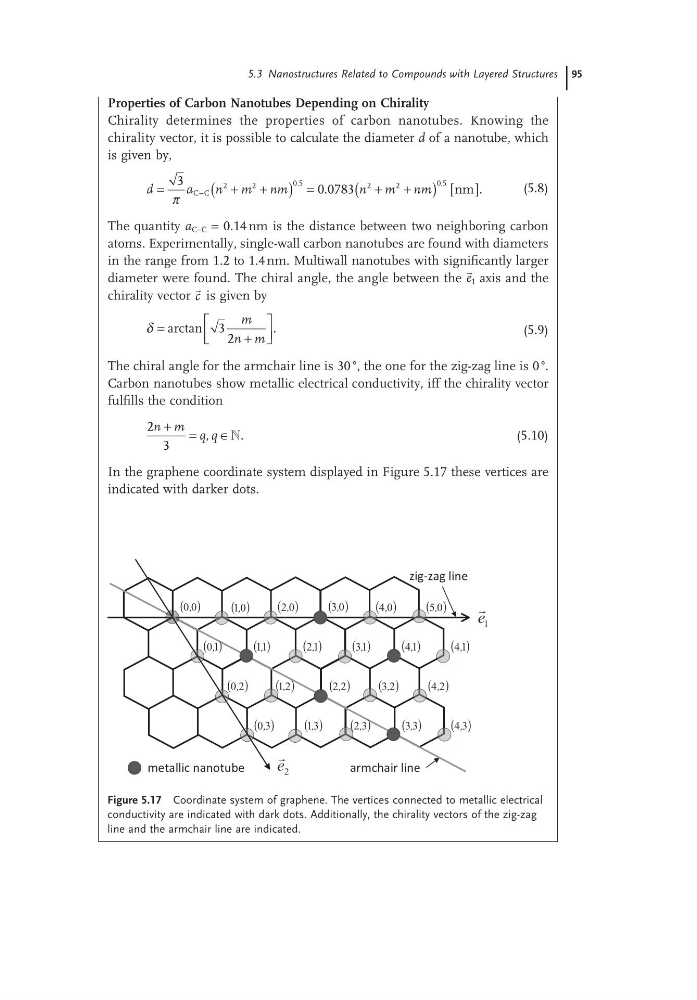
In the graphene coordinate system displayed in Figure 5.17 these vertices are
indicated with darker dots.
Figure 5.17 Coordinate system of graphene. The vertices connected to metallic electrical
conductivity are indicated with dark dots. Additionally, the chirality vectors of the zig-zag
line and the armchair line are indicated.
1
e
2
e
( )
0
0,
( )
2
4,
( )
0
1,
( )
0
3,
( )
0
2,
( )
0
4,
( )
0
5,
( )
2
3,
( )
2
2,
( )
1
1,
( )
1
2,
( )
1
3,
( )
1
4,
( )
1
4,
( )
3
3,
( )
3
4,
( )
3
2,
( )
2
1,
( )
1
0,
( )
2
0,
( )
3
0,
( )
3
1,
armchair line
zig-zag line
metallic nanotube
Properties of Carbon Nanotubes Depending on Chirality
Chirality determines the properties of carbon nanotubes. Knowing the
chiral ity vector, it is possible to calculate the diameter d of a nanotube, which
is given by,
d
a
n m nm
n m nm
=
+
+
(
) =
+
+
(
) [ ]
−
3
0 0783
2
2
0 5
2
2
0 5
π
C C
nm
.
.
.
.
(5.8)
The quantity a C−C = 0.14 nm is the distance between two neighboring carbon
atoms. Experimentally, single-wall carbon nanotubes are found with diameters
in the range from 1.2 to 1.4 nm. Multiwall nanotubes with significantly larger
diameter were found. The chiral angle, the angle between the
e 1 axis and the
chirality vector
c is given by
δ =
+
arctan 3 2
m
n m
.
(5.9)
The chiral angle for the armchair line is 30 °, the one for the zig-zag line is 0 °.
Carbon nanotubes show metallic electrical conductivity, iff the chirality vector
fulfills the condition
2
3
n m q q
+ =
∈
,
.
»
(5.10)
In the graphene coordinate system displayed in Figure 5.17 these vertices are
indicated with darker dots.
Figure 5.17 Coordinate system of graphene. The vertices connected to metallic electrical
conductivity are indicated with dark dots. Additionally, the chirality vectors of the zig-zag
line and the armchair line are indicated.
1
e
2
e
( )
0
0,
( )
2
4,
( )
0
1,
( )
0
3,
( )
0
2,
( )
0
4,
( )
0
5,
( )
2
3,
( )
2
2,
( )
1
1,
( )
1
2,
( )
1
3,
( )
1
4,
( )
1
4,
( )
3
3,
( )
3
4,
( )
3
2,
( )
2
1,
( )
1
0,
( )
2
0,
( )
3
0,
( )
3
1,
armchair line
zig-zag line
metallic nanotube