

6. When the built process has finished, extract non-reacted resin
by dipping the 3D structures in a 3:1 mixture of isopropanol/
acetone for 30 min.
7. Post-cure porous scaffolds in oven at 90
C for 24 h under
vacuum.
4 Notes
1. Although methods have been optimized for use with this particular SLA equipment, they can easily be adapted to other
printers.
2. To design porous 3D structures, TPMS have been adopted
with Gyroid (G) and Diamond architectures [23, 24].
K3DSurf v0.6.2 software (http://k3dsurf.sourceforge.net)
can be used to generate CAD files that describe the surfaces
of Gyroid and Diamond geometries. The trigonometric functions that describe Gyroid and Diamond surface are reported in
Eqs. 2 and 3:
cos x
ð Þ sin y
ð Þ þ cos y
ð Þ sin z
ð Þ þ cos z
ð Þ sin x
ð Þ ¼ C
ð2Þ
sin x
ð Þ sin y
ð Þ sin z
ð Þ þ sin x
ð Þ cos y
ð Þ cos z
ð Þ
þ cos x
ð Þ sin y
ð Þ cos z
ð Þ þ cos x
ð Þ cos y
ð Þ cos z
ð Þ
¼ C
ð3Þ
3. To obtain cylindrical structures with a porosity of ca. 60–70%,
an offset value (C) of 0.5 for Gyroid and 0.2 for Diamond can
be used with boundary conditions x, y ¼ [À6π; 6π] and
z ¼ [À3π; 3π] (Fig. 3).
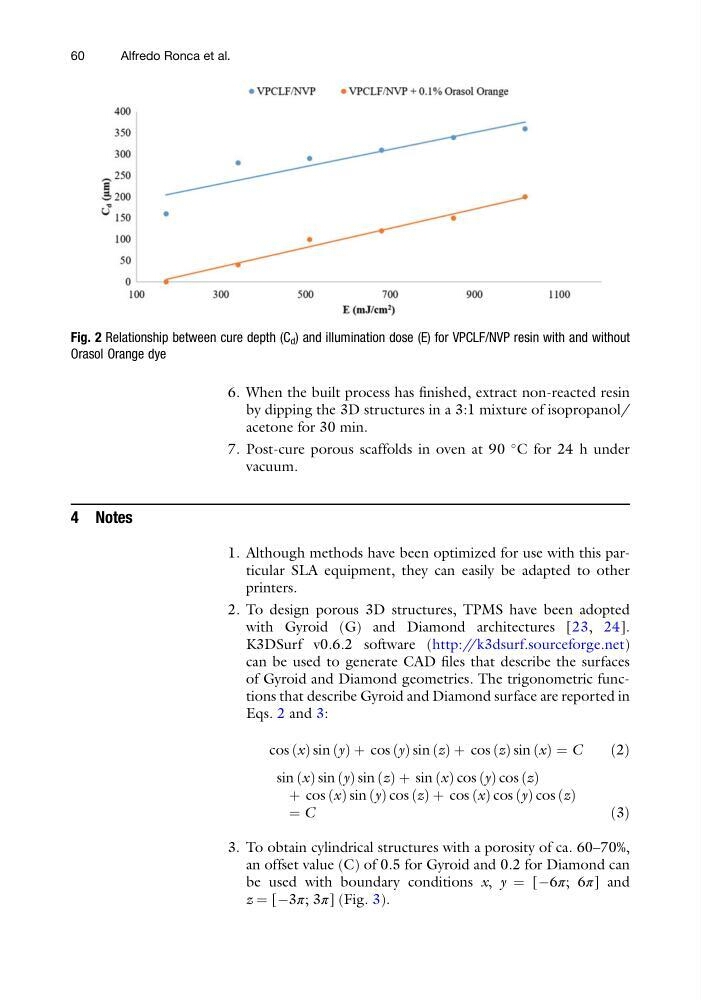
Fig. 2 Relationship between cure depth (C d ) and illumination dose (E) for VPCLF/NVP resin with and without
Orasol Orange dye
60
Alfredo Ronca et al.
by dipping the 3D structures in a 3:1 mixture of isopropanol/
acetone for 30 min.
7. Post-cure porous scaffolds in oven at 90
C for 24 h under
vacuum.
4 Notes
1. Although methods have been optimized for use with this particular SLA equipment, they can easily be adapted to other
printers.
2. To design porous 3D structures, TPMS have been adopted
with Gyroid (G) and Diamond architectures [23, 24].
K3DSurf v0.6.2 software (http://k3dsurf.sourceforge.net)
can be used to generate CAD files that describe the surfaces
of Gyroid and Diamond geometries. The trigonometric functions that describe Gyroid and Diamond surface are reported in
Eqs. 2 and 3:
cos x
ð Þ sin y
ð Þ þ cos y
ð Þ sin z
ð Þ þ cos z
ð Þ sin x
ð Þ ¼ C
ð2Þ
sin x
ð Þ sin y
ð Þ sin z
ð Þ þ sin x
ð Þ cos y
ð Þ cos z
ð Þ
þ cos x
ð Þ sin y
ð Þ cos z
ð Þ þ cos x
ð Þ cos y
ð Þ cos z
ð Þ
¼ C
ð3Þ
3. To obtain cylindrical structures with a porosity of ca. 60–70%,
an offset value (C) of 0.5 for Gyroid and 0.2 for Diamond can
be used with boundary conditions x, y ¼ [À6π; 6π] and
z ¼ [À3π; 3π] (Fig. 3).
Fig. 2 Relationship between cure depth (C d ) and illumination dose (E) for VPCLF/NVP resin with and without
Orasol Orange dye
60
Alfredo Ronca et al.