

4. Separate the supernatant from unreacted K 2 CO 3 , and precipitate the polymer in cold methanol, filter on a Buchner filter,
and wash with methanol/water to remove any unreacted chemicals and reaction by-products.
5. Further purify VPCLF by redissolution in DCM and
re-precipitation in methanol before drying in a vacuum oven
at 30
C for one night.
3.3 Stereolithography Process
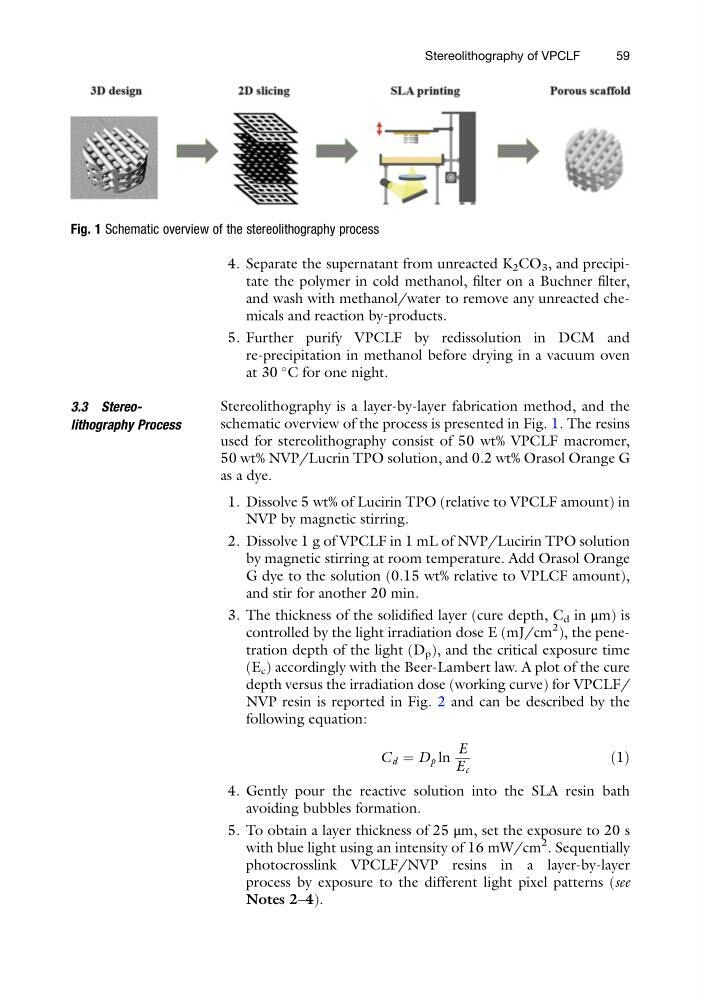
Stereolithography is a layer-by-layer fabrication method, and the
schematic overview of the process is presented in Fig. 1. The resins
used for stereolithography consist of 50 wt% VPCLF macromer,
50 wt% NVP/Lucrin TPO solution, and 0.2 wt% Orasol Orange G
as a dye.
1. Dissolve 5 wt% of Lucirin TPO (relative to VPCLF amount) in
NVP by magnetic stirring.
2. Dissolve 1 g of VPCLF in 1 mL of NVP/Lucirin TPO solution
by magnetic stirring at room temperature. Add Orasol Orange
G dye to the solution (0.15 wt% relative to VPLCF amount),
and stir for another 20 min.
3. The thickness of the solidified layer (cure depth, C d in μm) is
controlled by the light irradiation dose E (mJ/cm
2
), the penetration depth of the light (D p ), and the critical exposure time
(E c ) accordingly with the Beer-Lambert law. A plot of the cure
depth versus the irradiation dose (working curve) for VPCLF/
NVP resin is reported in Fig. 2 and can be described by the
following equation:
C d ¼ D p ln
E
E c
ð1Þ
4. Gently pour the reactive solution into the SLA resin bath
avoiding bubbles formation.
5. To obtain a layer thickness of 25 μm, set the exposure to 20 s
with blue light using an intensity of 16 mW/cm
2
. Sequentially
photocrosslink VPCLF/NVP resins in a layer-by-layer
process by exposure to the different light pixel patterns (see
Notes 2–4).
Fig. 1 Schematic overview of the stereolithography process
Stereolithography of VPCLF
59
and wash with methanol/water to remove any unreacted chemicals and reaction by-products.
5. Further purify VPCLF by redissolution in DCM and
re-precipitation in methanol before drying in a vacuum oven
at 30
C for one night.
3.3 Stereolithography Process
Stereolithography is a layer-by-layer fabrication method, and the
schematic overview of the process is presented in Fig. 1. The resins
used for stereolithography consist of 50 wt% VPCLF macromer,
50 wt% NVP/Lucrin TPO solution, and 0.2 wt% Orasol Orange G
as a dye.
1. Dissolve 5 wt% of Lucirin TPO (relative to VPCLF amount) in
NVP by magnetic stirring.
2. Dissolve 1 g of VPCLF in 1 mL of NVP/Lucirin TPO solution
by magnetic stirring at room temperature. Add Orasol Orange
G dye to the solution (0.15 wt% relative to VPLCF amount),
and stir for another 20 min.
3. The thickness of the solidified layer (cure depth, C d in μm) is
controlled by the light irradiation dose E (mJ/cm
2
), the penetration depth of the light (D p ), and the critical exposure time
(E c ) accordingly with the Beer-Lambert law. A plot of the cure
depth versus the irradiation dose (working curve) for VPCLF/
NVP resin is reported in Fig. 2 and can be described by the
following equation:
C d ¼ D p ln
E
E c
ð1Þ
4. Gently pour the reactive solution into the SLA resin bath
avoiding bubbles formation.
5. To obtain a layer thickness of 25 μm, set the exposure to 20 s
with blue light using an intensity of 16 mW/cm
2
. Sequentially
photocrosslink VPCLF/NVP resins in a layer-by-layer
process by exposure to the different light pixel patterns (see
Notes 2–4).
Fig. 1 Schematic overview of the stereolithography process
Stereolithography of VPCLF
59