

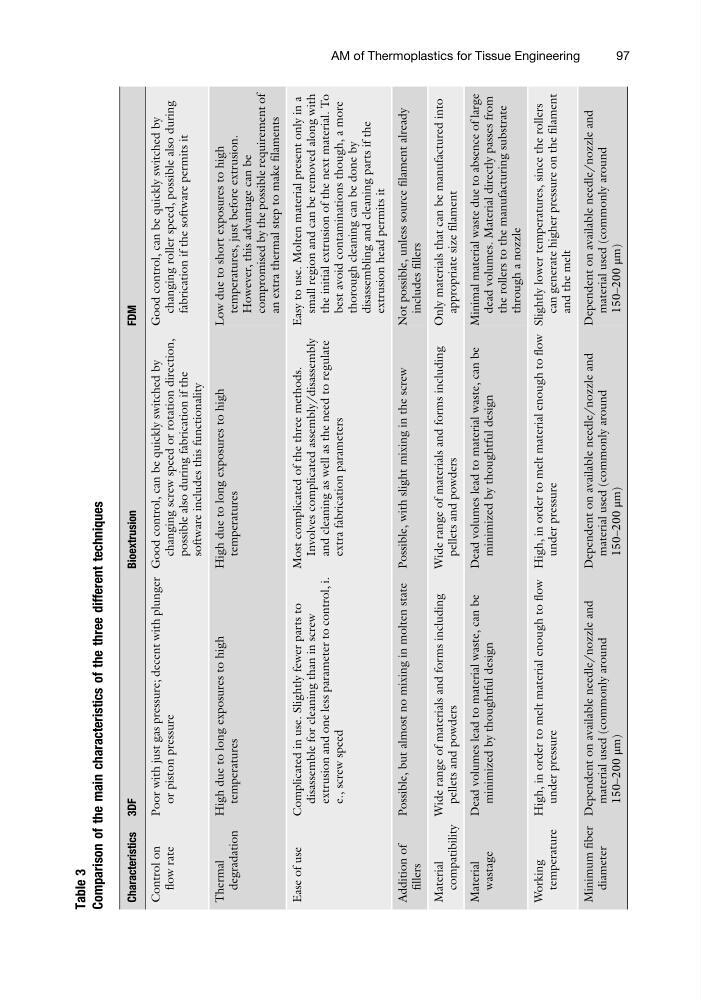
Table 3
Comparison of the main characteristics of the three different techniques
Characteristics 3DF
Bioextrusion
FDM
Control on
flow rate
Poor with just gas pressure; decent with plunger
or piston pressure
Good control, can be quickly switched by
changing screw speed or rotation direction,
possible also during fabrication if the
software includes this functionality
Good control, can be quickly switched by
changing roller speed, possible also during
fabrication if the software permits it
Thermal
degradation
High due to long exposures to high
temperatures
High due to long exposures to high
temperatures
Low due to short exposures to high
temperatures, just before extrusion.
However, this advantage can be
compromised by the possible requirement of
an extra thermal step to make filaments
Ease of use
Complicated in use. Slightly fewer parts to
disassemble for cleaning than in screw
extrusion and one less parameter to control, i.
e., screw speed
Most complicated of the three methods.
Involves complicated assembly/disassembly
and cleaning as well as the need to regulate
extra fabrication parameters
Easy to use. Molten material present only in a
small region and can be removed along with
the initial extrusion of the next material. To
best avoid contaminations though, a more
thorough cleaning can be done by
disassembling and cleaning parts if the
extrusion head permits it
Addition of
fillers
Possible, but almost no mixing in molten state Possible, with slight mixing in the screw
Not possible, unless source filament already
includes fillers
Material
compatibility
Wide range of materials and forms including
pellets and powders
Wide range of materials and forms including
pellets and powders
Only materials that can be manufactured into
appropriate size filament
Material
wastage
Dead volumes lead to material waste, can be
minimized by thoughtful design
Dead volumes lead to material waste, can be
minimized by thoughtful design
Minimal material waste due to absence of large
dead volumes. Material directly passes from
the rollers to the manufacturing substrate
through a nozzle
Working
temperature
High, in order to melt material enough to flow
under pressure
High, in order to melt material enough to flow
under pressure
Slightly lower temperatures, since the rollers
can generate higher pressure on the filament
and the melt
Minimum fiber
diameter
Dependent on available needle/nozzle and
material used (commonly around
150–200
μm)
Dependent on available needle/nozzle and
material used (commonly around
150–200
μm)
Dependent on available needle/nozzle and
material used (commonly around
150–200
μm)
AM of Thermoplastics for Tissue Engineering
97
Comparison of the main characteristics of the three different techniques
Characteristics 3DF
Bioextrusion
FDM
Control on
flow rate
Poor with just gas pressure; decent with plunger
or piston pressure
Good control, can be quickly switched by
changing screw speed or rotation direction,
possible also during fabrication if the
software includes this functionality
Good control, can be quickly switched by
changing roller speed, possible also during
fabrication if the software permits it
Thermal
degradation
High due to long exposures to high
temperatures
High due to long exposures to high
temperatures
Low due to short exposures to high
temperatures, just before extrusion.
However, this advantage can be
compromised by the possible requirement of
an extra thermal step to make filaments
Ease of use
Complicated in use. Slightly fewer parts to
disassemble for cleaning than in screw
extrusion and one less parameter to control, i.
e., screw speed
Most complicated of the three methods.
Involves complicated assembly/disassembly
and cleaning as well as the need to regulate
extra fabrication parameters
Easy to use. Molten material present only in a
small region and can be removed along with
the initial extrusion of the next material. To
best avoid contaminations though, a more
thorough cleaning can be done by
disassembling and cleaning parts if the
extrusion head permits it
Addition of
fillers
Possible, but almost no mixing in molten state Possible, with slight mixing in the screw
Not possible, unless source filament already
includes fillers
Material
compatibility
Wide range of materials and forms including
pellets and powders
Wide range of materials and forms including
pellets and powders
Only materials that can be manufactured into
appropriate size filament
Material
wastage
Dead volumes lead to material waste, can be
minimized by thoughtful design
Dead volumes lead to material waste, can be
minimized by thoughtful design
Minimal material waste due to absence of large
dead volumes. Material directly passes from
the rollers to the manufacturing substrate
through a nozzle
Working
temperature
High, in order to melt material enough to flow
under pressure
High, in order to melt material enough to flow
under pressure
Slightly lower temperatures, since the rollers
can generate higher pressure on the filament
and the melt
Minimum fiber
diameter
Dependent on available needle/nozzle and
material used (commonly around
150–200
μm)
Dependent on available needle/nozzle and
material used (commonly around
150–200
μm)
Dependent on available needle/nozzle and
material used (commonly around
150–200
μm)
AM of Thermoplastics for Tissue Engineering
97