

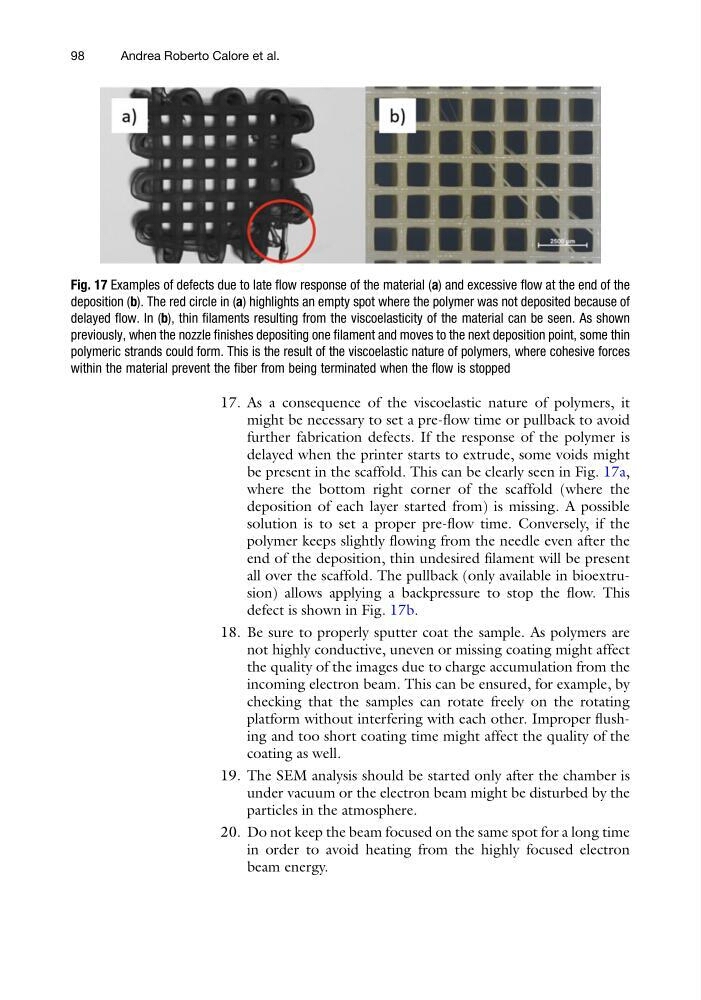
17. As a consequence of the viscoelastic nature of polymers, it
might be necessary to set a pre-flow time or pullback to avoid
further fabrication defects. If the response of the polymer is
delayed when the printer starts to extrude, some voids might
be present in the scaffold. This can be clearly seen in Fig. 17a,
where the bottom right corner of the scaffold (where the
deposition of each layer started from) is missing. A possible
solution is to set a proper pre-flow time. Conversely, if the
polymer keeps slightly flowing from the needle even after the
end of the deposition, thin undesired filament will be present
all over the scaffold. The pullback (only available in bioextrusion) allows applying a backpressure to stop the flow. This
defect is shown in Fig. 17b.
18. Be sure to properly sputter coat the sample. As polymers are
not highly conductive, uneven or missing coating might affect
the quality of the images due to charge accumulation from the
incoming electron beam. This can be ensured, for example, by
checking that the samples can rotate freely on the rotating
platform without interfering with each other. Improper flushing and too short coating time might affect the quality of the
coating as well.
19. The SEM analysis should be started only after the chamber is
under vacuum or the electron beam might be disturbed by the
particles in the atmosphere.
20. Do not keep the beam focused on the same spot for a long time
in order to avoid heating from the highly focused electron
beam energy.
Fig. 17 Examples of defects due to late flow response of the material (a) and excessive flow at the end of the
deposition (b). The red circle in (a) highlights an empty spot where the polymer was not deposited because of
delayed flow. In (b), thin filaments resulting from the viscoelasticity of the material can be seen. As shown
previously, when the nozzle finishes depositing one filament and moves to the next deposition point, some thin
polymeric strands could form. This is the result of the viscoelastic nature of polymers, where cohesive forces
within the material prevent the fiber from being terminated when the flow is stopped
98
Andrea Roberto Calore et al.
might be necessary to set a pre-flow time or pullback to avoid
further fabrication defects. If the response of the polymer is
delayed when the printer starts to extrude, some voids might
be present in the scaffold. This can be clearly seen in Fig. 17a,
where the bottom right corner of the scaffold (where the
deposition of each layer started from) is missing. A possible
solution is to set a proper pre-flow time. Conversely, if the
polymer keeps slightly flowing from the needle even after the
end of the deposition, thin undesired filament will be present
all over the scaffold. The pullback (only available in bioextrusion) allows applying a backpressure to stop the flow. This
defect is shown in Fig. 17b.
18. Be sure to properly sputter coat the sample. As polymers are
not highly conductive, uneven or missing coating might affect
the quality of the images due to charge accumulation from the
incoming electron beam. This can be ensured, for example, by
checking that the samples can rotate freely on the rotating
platform without interfering with each other. Improper flushing and too short coating time might affect the quality of the
coating as well.
19. The SEM analysis should be started only after the chamber is
under vacuum or the electron beam might be disturbed by the
particles in the atmosphere.
20. Do not keep the beam focused on the same spot for a long time
in order to avoid heating from the highly focused electron
beam energy.
Fig. 17 Examples of defects due to late flow response of the material (a) and excessive flow at the end of the
deposition (b). The red circle in (a) highlights an empty spot where the polymer was not deposited because of
delayed flow. In (b), thin filaments resulting from the viscoelasticity of the material can be seen. As shown
previously, when the nozzle finishes depositing one filament and moves to the next deposition point, some thin
polymeric strands could form. This is the result of the viscoelastic nature of polymers, where cohesive forces
within the material prevent the fiber from being terminated when the flow is stopped
98
Andrea Roberto Calore et al.