

6. To avoid unnecessary additional thermal stress on the sample
during rheometry, perform sample loading as fast as possible.
In case of thermally unstable materials, one can also pre-shape a
disc via compression molding or preferred solution casting
excluding any negative thermal effects prior to measurement.
7. Before setting the measurement gap, wait for the temperature
to stabilize. During reheating after trimming, the sample viscosity could drop again, and material flow out of the plate
might take place.
8. If the measuring gap is too big and the sample exhibits low
viscosity, there might be outflow of material resulting in a
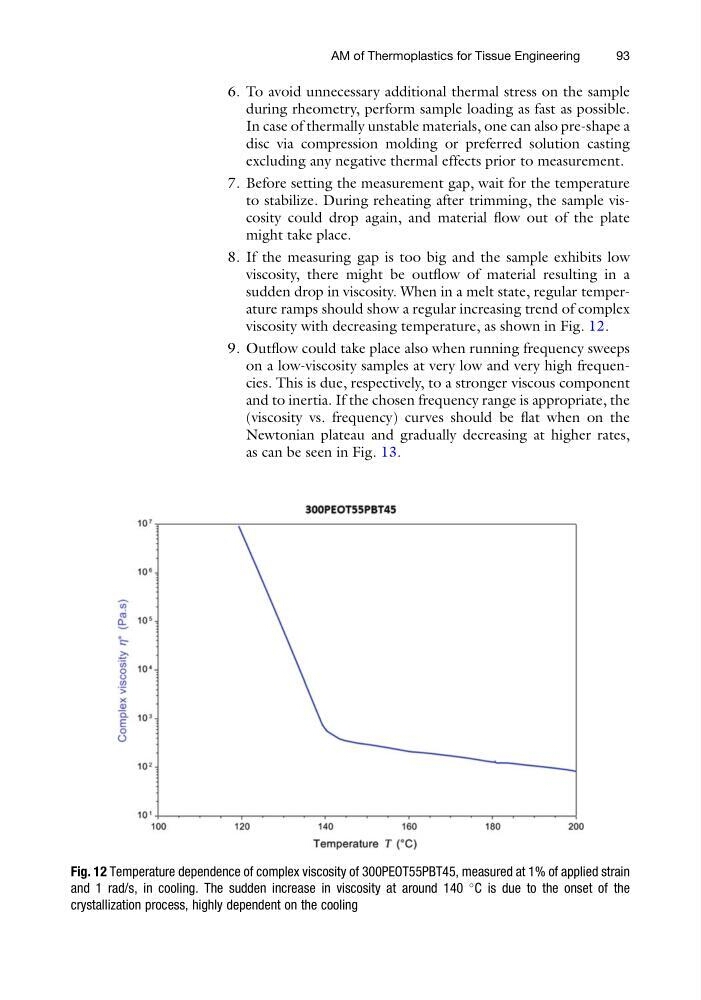
sudden drop in viscosity. When in a melt state, regular temperature ramps should show a regular increasing trend of complex
viscosity with decreasing temperature, as shown in Fig. 12.
9. Outflow could take place also when running frequency sweeps
on a low-viscosity samples at very low and very high frequencies. This is due, respectively, to a stronger viscous component
and to inertia. If the chosen frequency range is appropriate, the
(viscosity vs. frequency) curves should be flat when on the
Newtonian plateau and gradually decreasing at higher rates,
as can be seen in Fig. 13.
Fig. 12 Temperature dependence of complex viscosity of 300PEOT55PBT45, measured at 1% of applied strain
and 1 rad/s, in cooling. The sudden increase in viscosity at around 140
C is due to the onset of the
crystallization process, highly dependent on the cooling
AM of Thermoplastics for Tissue Engineering
93
during rheometry, perform sample loading as fast as possible.
In case of thermally unstable materials, one can also pre-shape a
disc via compression molding or preferred solution casting
excluding any negative thermal effects prior to measurement.
7. Before setting the measurement gap, wait for the temperature
to stabilize. During reheating after trimming, the sample viscosity could drop again, and material flow out of the plate
might take place.
8. If the measuring gap is too big and the sample exhibits low
viscosity, there might be outflow of material resulting in a
sudden drop in viscosity. When in a melt state, regular temperature ramps should show a regular increasing trend of complex
viscosity with decreasing temperature, as shown in Fig. 12.
9. Outflow could take place also when running frequency sweeps
on a low-viscosity samples at very low and very high frequencies. This is due, respectively, to a stronger viscous component
and to inertia. If the chosen frequency range is appropriate, the
(viscosity vs. frequency) curves should be flat when on the
Newtonian plateau and gradually decreasing at higher rates,
as can be seen in Fig. 13.
Fig. 12 Temperature dependence of complex viscosity of 300PEOT55PBT45, measured at 1% of applied strain
and 1 rad/s, in cooling. The sudden increase in viscosity at around 140
C is due to the onset of the
crystallization process, highly dependent on the cooling
AM of Thermoplastics for Tissue Engineering
93