

Nanostructured Electrolytic Composites Based on Cobalt Alloys …
749
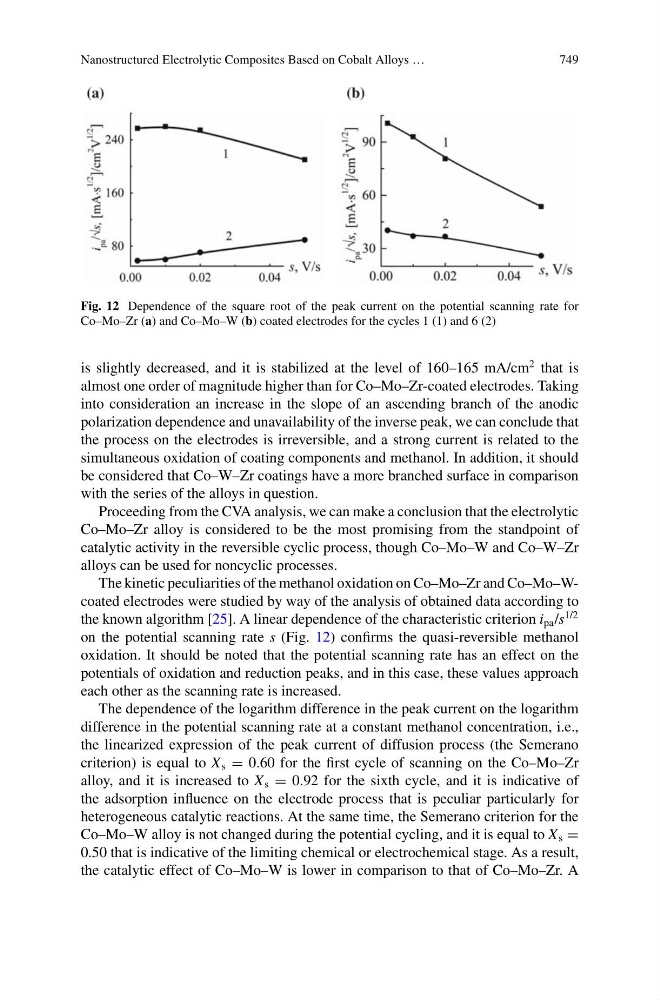
Fig. 12 Dependence of the square root of the peak current on the potential scanning rate for
Co–Mo–Zr (a) and Co–Mo–W (b) coated electrodes for the cycles 1 (1) and 6 (2)
is slightly decreased, and it is stabilized at the level of 160–165 mA/cm
2 that is
almost one order of magnitude higher than for Co–Mo–Zr-coated electrodes. Taking
into consideration an increase in the slope of an ascending branch of the anodic
polarization dependence and unavailability of the inverse peak, we can conclude that
the process on the electrodes is irreversible, and a strong current is related to the
simultaneous oxidation of coating components and methanol. In addition, it should
be considered that Co–W–Zr coatings have a more branched surface in comparison
with the series of the alloys in question.
Proceeding from the CVA analysis, we can make a conclusion that the electrolytic
Co–Mo–Zr alloy is considered to be the most promising from the standpoint of
catalytic activity in the reversible cyclic process, though Co–Mo–W and Co–W–Zr
alloys can be used for noncyclic processes.
The kinetic peculiarities of the methanol oxidation on Co–Mo–Zr and Co–Mo–Wcoated electrodes were studied by way of the analysis of obtained data according to
the known algorithm [25]. A linear dependence of the characteristic criterion i pa /s
1/2
on the potential scanning rate s (Fig. 12) confirms the quasi-reversible methanol
oxidation. It should be noted that the potential scanning rate has an effect on the
potentials of oxidation and reduction peaks, and in this case, these values approach
each other as the scanning rate is increased.
The dependence of the logarithm difference in the peak current on the logarithm
difference in the potential scanning rate at a constant methanol concentration, i.e.,
the linearized expression of the peak current of diffusion process (the Semerano
criterion) is equal to X s = 0.60 for the first cycle of scanning on the Co–Mo–Zr
alloy, and it is increased to X s = 0.92 for the sixth cycle, and it is indicative of
the adsorption influence on the electrode process that is peculiar particularly for
heterogeneous catalytic reactions. At the same time, the Semerano criterion for the
Co–Mo–W alloy is not changed during the potential cycling, and it is equal to X s =
0.50 that is indicative of the limiting chemical or electrochemical stage. As a result,
the catalytic effect of Co–Mo–W is lower in comparison to that of Co–Mo–Zr. A