

748
M. Ved’ et al.
This behavior can be explained by the fact that particularly the intermediate oxides of
alloying metals that are formed in the anodic process are reduced during the inverse
polarization, i.e., the mechanism suggested in this paper that includes the stages (4)
and (5) is realized.
A comparative analysis of the CVA shows that the activity of Co–Mo–Zr-coated
electrodes in the methanol oxidation reaction is considerably higher than that of
Co–Mo–W and platinum because the oxidation peak current is higher by a factor of
2.0–2.5 (Fig. 10). Such an increased efficiency of the electrodes can be explained by
a higher degree of the surface branching (see Fig. 1), and the synergetic effect of the
metals, in particular cobalt, molybdenum, and zirconium that are characterized by
the different stable oxidation degrees and the affinity to oxygen [8, 9, 20].
It should be noted that methanol oxidation waves on the alloys are symmetric
relatively i p , and it confirms the availability of the adsorption stage and is indicative
of the reaction quasi-reversibility. The oxidation peak current is increased in the
range from the first cycle to the second cycle, and then it is decreased and stabilized
by the fifth cycle at the level from 16 up to 18 mA/cm
2 ; the half-peak anode potentials
are decreased, and it is indicative of a decrease in the overpotential. Starting from the
second cycle, the inverse behavior of CVA is actually not changed, i.e., the process
becomes more stable, and as for Co–Mo–W-coated electrode, it progresses according
to the stages (4) and (5).
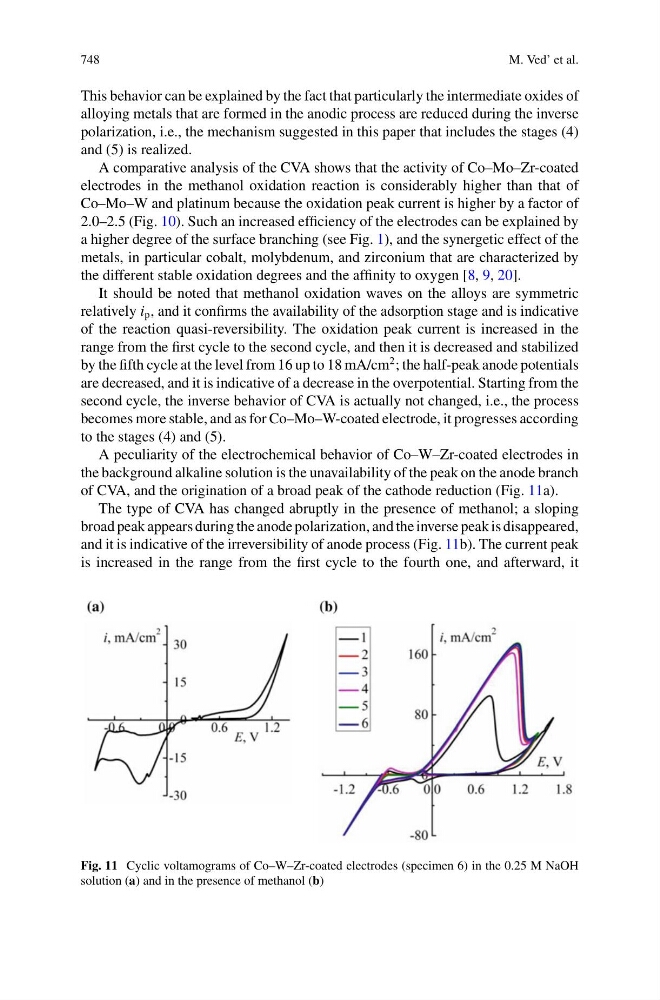
A peculiarity of the electrochemical behavior of Co–W–Zr-coated electrodes in
the background alkaline solution is the unavailability of the peak on the anode branch
of CVA, and the origination of a broad peak of the cathode reduction (Fig. 11a).
The type of CVA has changed abruptly in the presence of methanol; a sloping
broad peak appears during the anode polarization, and the inverse peak is disappeared,
and it is indicative of the irreversibility of anode process (Fig. 11b). The current peak
is increased in the range from the first cycle to the fourth one, and afterward, it
Fig. 11 Cyclic voltamograms of Co–W–Zr-coated electrodes (specimen 6) in the 0.25 M NaOH
solution (a) and in the presence of methanol (b)