

Nanostructured Electrolytic Composites Based on Cobalt Alloys …
747
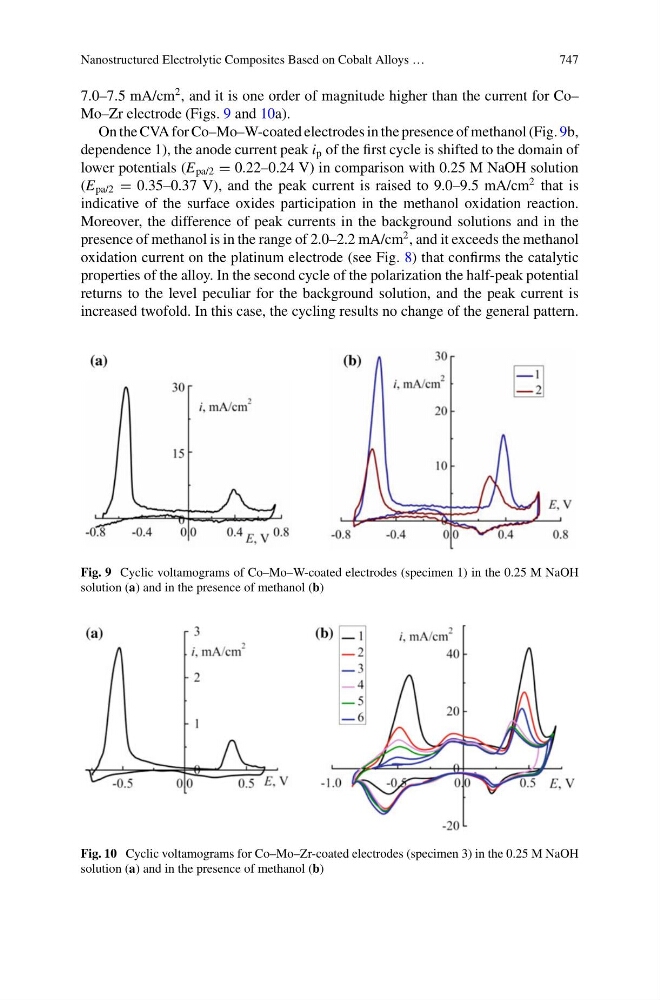
7.0–7.5 mA/cm
2 , and it is one order of magnitude higher than the current for Co–
Mo–Zr electrode (Figs. 9 and 10a).
On the CVA for Co–Mo–W-coated electrodes in the presence of methanol (Fig. 9b,
dependence 1), the anode current peak i p of the first cycle is shifted to the domain of
lower potentials (E pa/2 = 0.22–0.24 V) in comparison with 0.25 M NaOH solution
(E pa/2 = 0.35–0.37 V), and the peak current is raised to 9.0–9.5 mA/cm
2 that is
indicative of the surface oxides participation in the methanol oxidation reaction.
Moreover, the difference of peak currents in the background solutions and in the
presence of methanol is in the range of 2.0–2.2 mA/cm
2 , and it exceeds the methanol
oxidation current on the platinum electrode (see Fig. 8) that confirms the catalytic
properties of the alloy. In the second cycle of the polarization the half-peak potential
returns to the level peculiar for the background solution, and the peak current is
increased twofold. In this case, the cycling results no change of the general pattern.
Fig. 9 Cyclic voltamograms of Co–Mo–W-coated electrodes (specimen 1) in the 0.25 M NaOH
solution (a) and in the presence of methanol (b)
Fig. 10 Cyclic voltamograms for Co–Mo–Zr-coated electrodes (specimen 3) in the 0.25 M NaOH
solution (a) and in the presence of methanol (b)