

746
M. Ved’ et al.
error of 5–7%, we present data only for specimen 3 (Co–Mo–Zr) and specimen 6
(Co–W–Zr) (Table 2) obtained at similar electrolysis conditions. The higher values
R2 and R3 for specimen 3 in comparison with specimen 2 are due to the presence on
the surface stoichiometric zirconium oxide ZrO 2 with high both electrical resistivity
and chemical stability.
It should also be noted that the chemical stability of molybdenum oxides in an
alkaline medium is higher than that of tungsten. Therefore, the parameters R2 and R3
for specimen 6 are lower compared to sample 3. The results for Co–Mo–Zr coatings
are more reproducible than for Co–Mo–W ones, which makes it possible to consider
Co–Mo–Zr alloy to be more corrosively stable in an alkaline environment. Moreover,
we can conclude that coatings with metallic phases of Mo or W are characterized by
higher corrosion resistance.
Electrocatalytic properties of Co–Mo–W and Co–Mo(W)–Zr-coated electrodes
were studied using the model methanol oxidation reaction in the 1 M CH 3 OH solution
against the background of 0.25 M NaOH using the method of cyclic voltamometry
(CVA), and the obtained data were compared with those for the electrochemical
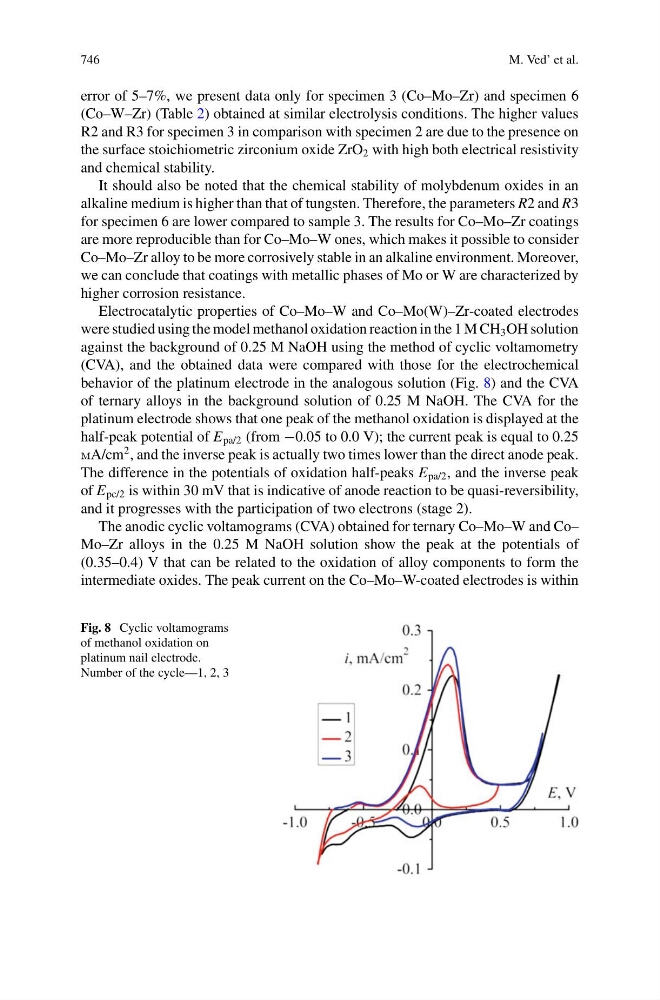
behavior of the platinum electrode in the analogous solution (Fig. 8) and the CVA
of ternary alloys in the background solution of 0.25 M NaOH. The CVA for the
platinum electrode shows that one peak of the methanol oxidation is displayed at the
half-peak potential of E pa/2 (from −0.05 to 0.0 V); the current peak is equal to 0.25
mA/cm
2 , and the inverse peak is actually two times lower than the direct anode peak.
The difference in the potentials of oxidation half-peaks E pa/2 , and the inverse peak
of E pc/2 is within 30 mV that is indicative of anode reaction to be quasi-reversibility,
and it progresses with the participation of two electrons (stage 2).
The anodic cyclic voltamograms (CVA) obtained for ternary Co–Mo–W and Co–
Mo–Zr alloys in the 0.25 M NaOH solution show the peak at the potentials of
(0.35–0.4) V that can be related to the oxidation of alloy components to form the
intermediate oxides. The peak current on the Co–Mo–W-coated electrodes is within
Fig. 8 Cyclic voltamograms
of methanol oxidation on
platinum nail electrode.
Number of the cycle—1, 2, 3