

750
M. Ved’ et al.
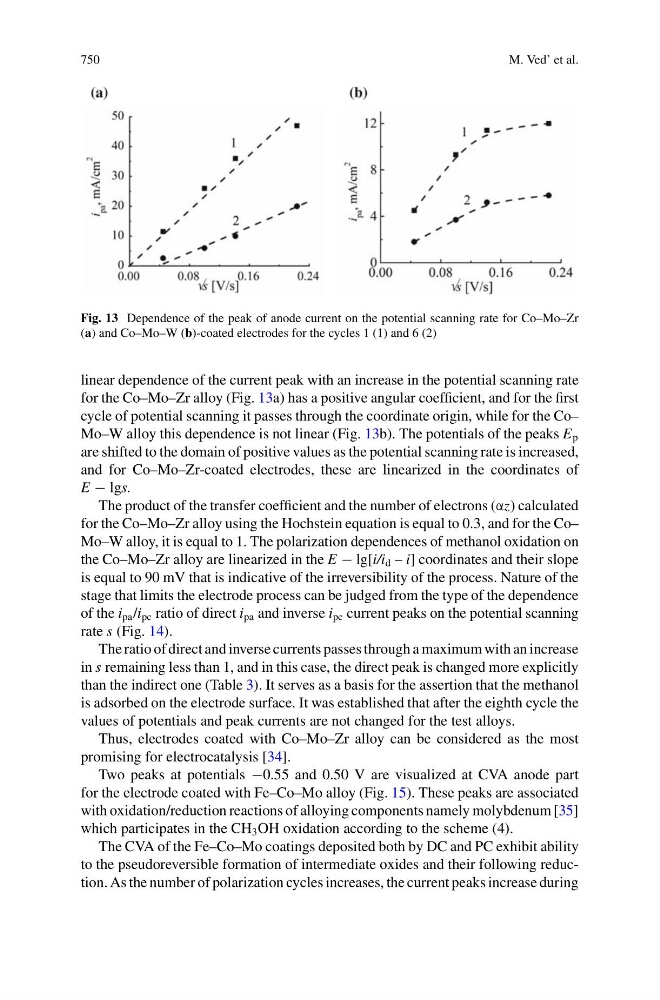
Fig. 13 Dependence of the peak of anode current on the potential scanning rate for Co–Mo–Zr
(a) and Co–Mo–W (b)-coated electrodes for the cycles 1 (1) and 6 (2)
linear dependence of the current peak with an increase in the potential scanning rate
for the Co–Mo–Zr alloy (Fig. 13a) has a positive angular coefficient, and for the first
cycle of potential scanning it passes through the coordinate origin, while for the Co–
Mo–W alloy this dependence is not linear (Fig. 13b). The potentials of the peaks E p
are shifted to the domain of positive values as the potential scanning rate is increased,
and for Co–Mo–Zr-coated electrodes, these are linearized in the coordinates of
E − lgs.
The product of the transfer coefficient and the number of electrons (αz) calculated
for the Co–Mo–Zr alloy using the Hochstein equation is equal to 0.3, and for the Co–
Mo–W alloy, it is equal to 1. The polarization dependences of methanol oxidation on
the Co–Mo–Zr alloy are linearized in the E − lg[i/i d – i] coordinates and their slope
is equal to 90 mV that is indicative of the irreversibility of the process. Nature of the
stage that limits the electrode process can be judged from the type of the dependence
of the i pa /i pc ratio of direct i pa and inverse i pc current peaks on the potential scanning
rate s (Fig. 14).
The ratio of direct and inverse currents passes through a maximum with an increase
in s remaining less than 1, and in this case, the direct peak is changed more explicitly
than the indirect one (Table 3). It serves as a basis for the assertion that the methanol
is adsorbed on the electrode surface. It was established that after the eighth cycle the
values of potentials and peak currents are not changed for the test alloys.
Thus, electrodes coated with Co–Mo–Zr alloy can be considered as the most
promising for electrocatalysis [34].
Two peaks at potentials −0.55 and 0.50 V are visualized at CVA anode part
for the electrode coated with Fe–Co–Mo alloy (Fig. 15). These peaks are associated
with oxidation/reduction reactions of alloying components namely molybdenum [35]
which participates in the CH 3 OH oxidation according to the scheme (4).
The CVA of the Fe–Co–Mo coatings deposited both by DC and PC exhibit ability
to the pseudoreversible formation of intermediate oxides and their following reduction. As the number of polarization cycles increases, the current peaks increase during