

52
A. V. Taran et al.
others. B 4 C has low mass density of 2.52 g/cm
3 (lightweight material), low thermal
expansion coefficient of 4.3 × 10
−6 K
−1 , high thermal and chemical stability, and
good wear resistance. But it was reported that B 4 C ceramics are hardly sinterable and
relatively brittle and thus face serious obstacles for any structural material because
of their low flexural strength (200–300 MPa) [7–9].
Various CVD and PVD methods are being applied to produce boron carbide coatings [10]. Two types of microstructures are reported by different authors, columnar
structure by DC magnetron sputtering, reactive sputtering, pulsed ion-beam evaporation and non-columnar, featureless grown films by DC magnetron sputtering, and
plasma jet CVD by PLD [10]. Hu et al. studied the effect of bias voltages on the
microstructure and found that boron carbide coatings deposited at floating potential
had coarse columnar microstructure, and at 200 V bias voltages it transformed to a
denser zone T-type microstructure. Knotek et al. studied the effect of argon pressure
on the microstructure of boron carbide coatings and found that the columnar structure
for the films deposited at 4 Pa changed to no structural growth at 1 Pa [10].
Considering mechanical properties, the softer boron carbide films were reported
by Chen et al. with 13 GPa for the films deposited without external heating [11] and by
Ahn et al. with 18 GPa was also reported [12]. Tribological studies on RF-deposited
boron carbide thin films demonstrated a quite different characteristic, especially
for friction coefficient evolution. Lower friction coefficients are compared to DCsputtered boron carbide films; about 0.4 were observed at the beginning of “pin-ondisk” tests instead of high values about 1 obtained for DC-sputtered films. Friction
coefficients are stabilized around 0.5, which is believed in the friction coefficient
value of RF-sputtered boron carbide films [10].
The development of vacuum-arc plasma coating methods for surface hardening is
a promising direction [13, 14], and therefore, the optimization of elemental and phase
composition and mechanical properties is an actual task. The aim of the research was
to study the possibility of using boron carbide coating to increase the wear resistance
of the working surfaces of parts made of low- and high-carbon steels.
2 Experimental Setup
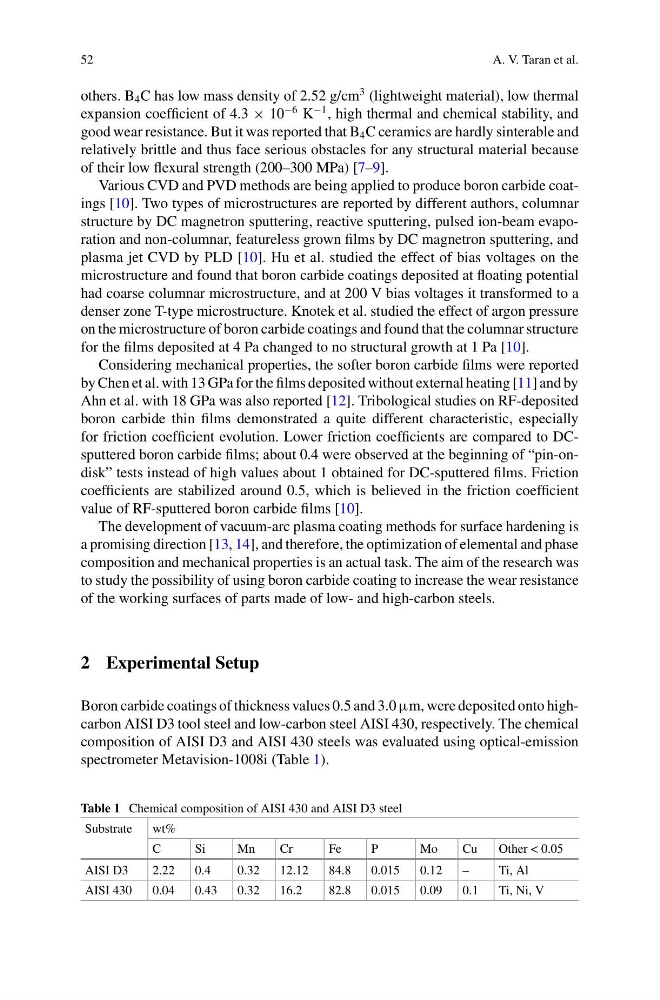
Boron carbide coatings of thickness values 0.5 and 3.0 µm, were deposited onto highcarbon AISI D3 tool steel and low-carbon steel AISI 430, respectively. The chemical
composition of AISI D3 and AISI 430 steels was evaluated using optical-emission
spectrometer Metavision-1008i (Table 1).
Table 1 Chemical composition of AISI 430 and AISI D3 steel
Substrate
wt%
C
Si
Mn
Cr
Fe
P
Mo
Cu
Other < 0.05
AISI D3
2.22
0.4
0.32
12.12
84.8
0.015
0.12
–
Ti, Al
AISI 430
0.04
0.43
0.32
16.2
82.8
0.015
0.09
0.1
Ti, Ni, V
A. V. Taran et al.
others. B 4 C has low mass density of 2.52 g/cm
3 (lightweight material), low thermal
expansion coefficient of 4.3 × 10
−6 K
−1 , high thermal and chemical stability, and
good wear resistance. But it was reported that B 4 C ceramics are hardly sinterable and
relatively brittle and thus face serious obstacles for any structural material because
of their low flexural strength (200–300 MPa) [7–9].
Various CVD and PVD methods are being applied to produce boron carbide coatings [10]. Two types of microstructures are reported by different authors, columnar
structure by DC magnetron sputtering, reactive sputtering, pulsed ion-beam evaporation and non-columnar, featureless grown films by DC magnetron sputtering, and
plasma jet CVD by PLD [10]. Hu et al. studied the effect of bias voltages on the
microstructure and found that boron carbide coatings deposited at floating potential
had coarse columnar microstructure, and at 200 V bias voltages it transformed to a
denser zone T-type microstructure. Knotek et al. studied the effect of argon pressure
on the microstructure of boron carbide coatings and found that the columnar structure
for the films deposited at 4 Pa changed to no structural growth at 1 Pa [10].
Considering mechanical properties, the softer boron carbide films were reported
by Chen et al. with 13 GPa for the films deposited without external heating [11] and by
Ahn et al. with 18 GPa was also reported [12]. Tribological studies on RF-deposited
boron carbide thin films demonstrated a quite different characteristic, especially
for friction coefficient evolution. Lower friction coefficients are compared to DCsputtered boron carbide films; about 0.4 were observed at the beginning of “pin-ondisk” tests instead of high values about 1 obtained for DC-sputtered films. Friction
coefficients are stabilized around 0.5, which is believed in the friction coefficient
value of RF-sputtered boron carbide films [10].
The development of vacuum-arc plasma coating methods for surface hardening is
a promising direction [13, 14], and therefore, the optimization of elemental and phase
composition and mechanical properties is an actual task. The aim of the research was
to study the possibility of using boron carbide coating to increase the wear resistance
of the working surfaces of parts made of low- and high-carbon steels.
2 Experimental Setup
Boron carbide coatings of thickness values 0.5 and 3.0 µm, were deposited onto highcarbon AISI D3 tool steel and low-carbon steel AISI 430, respectively. The chemical
composition of AISI D3 and AISI 430 steels was evaluated using optical-emission
spectrometer Metavision-1008i (Table 1).
Table 1 Chemical composition of AISI 430 and AISI D3 steel
Substrate
wt%
C
Si
Mn
Cr
Fe
P
Mo
Cu
Other < 0.05
AISI D3
2.22
0.4
0.32
12.12
84.8
0.015
0.12
–
Ti, Al
AISI 430
0.04
0.43
0.32
16.2
82.8
0.015
0.09
0.1
Ti, Ni, V