

742
M. Ved’ et al.
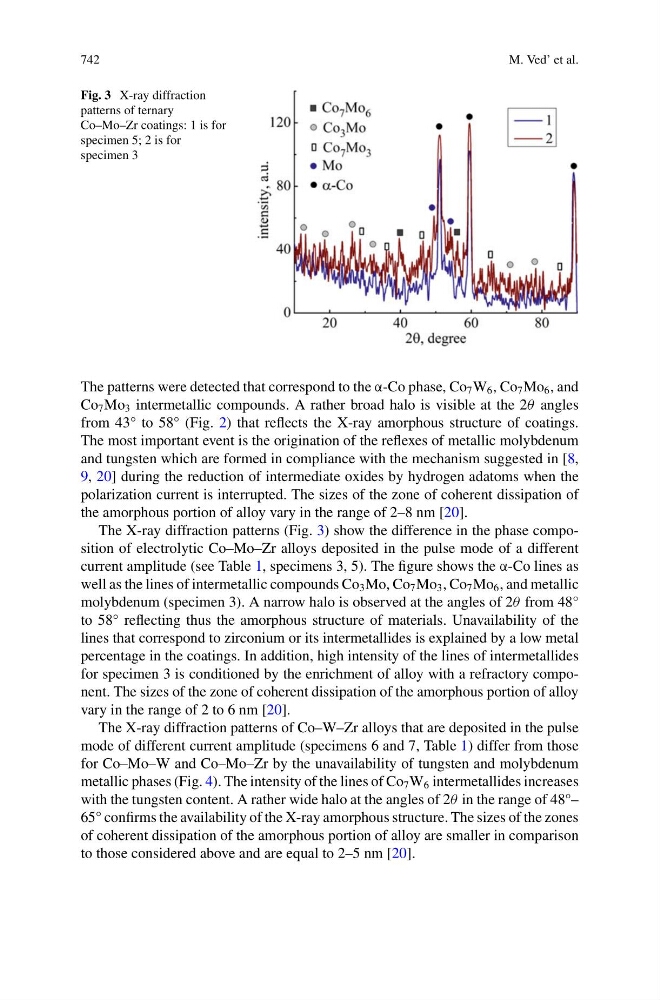
Fig. 3 X-ray diffraction
patterns of ternary
Co–Mo–Zr coatings: 1 is for
specimen 5; 2 is for
specimen 3
The patterns were detected that correspond to the α-Co phase, Co 7 W 6 , Co 7 Mo 6 , and
Co 7 Mo 3 intermetallic compounds. A rather broad halo is visible at the 2θ angles
from 43° to 58° (Fig. 2) that reflects the X-ray amorphous structure of coatings.
The most important event is the origination of the reflexes of metallic molybdenum
and tungsten which are formed in compliance with the mechanism suggested in [8,
9, 20] during the reduction of intermediate oxides by hydrogen adatoms when the
polarization current is interrupted. The sizes of the zone of coherent dissipation of
the amorphous portion of alloy vary in the range of 2–8 nm [20].
The X-ray diffraction patterns (Fig. 3) show the difference in the phase composition of electrolytic Co–Mo–Zr alloys deposited in the pulse mode of a different
current amplitude (see Table 1, specimens 3, 5). The figure shows the α-Co lines as
well as the lines of intermetallic compounds Co 3 Mo, Co 7 Mo 3 , Co 7 Mo 6 , and metallic
molybdenum (specimen 3). A narrow halo is observed at the angles of 2θ from 48°
to 58° reflecting thus the amorphous structure of materials. Unavailability of the
lines that correspond to zirconium or its intermetallides is explained by a low metal
percentage in the coatings. In addition, high intensity of the lines of intermetallides
for specimen 3 is conditioned by the enrichment of alloy with a refractory component. The sizes of the zone of coherent dissipation of the amorphous portion of alloy
vary in the range of 2 to 6 nm [20].
The X-ray diffraction patterns of Co–W–Zr alloys that are deposited in the pulse
mode of different current amplitude (specimens 6 and 7, Table 1) differ from those
for Co–Mo–W and Co–Mo–Zr by the unavailability of tungsten and molybdenum
metallic phases (Fig. 4). The intensity of the lines of Co 7 W 6 intermetallides increases
with the tungsten content. A rather wide halo at the angles of 2θ in the range of 48°–
65° confirms the availability of the X-ray amorphous structure. The sizes of the zones
of coherent dissipation of the amorphous portion of alloy are smaller in comparison
to those considered above and are equal to 2–5 nm [20].