

Nanostructured Electrolytic Composites Based on Cobalt Alloys …
743
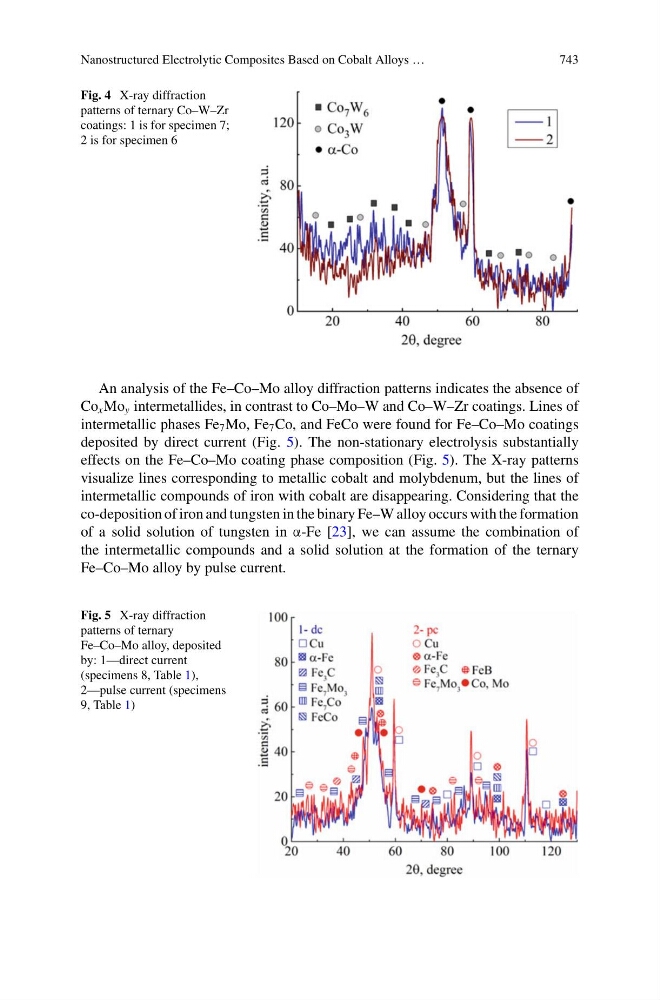
Fig. 4 X-ray diffraction
patterns of ternary Co–W–Zr
coatings: 1 is for specimen 7;
2 is for specimen 6
An analysis of the Fe–Co–Mo alloy diffraction patterns indicates the absence of
Co x Mo y intermetallides, in contrast to Co–Mo–W and Co–W–Zr coatings. Lines of
intermetallic phases Fe 7 Mo, Fe 7 Co, and FeCo were found for Fe–Co–Mo coatings
deposited by direct current (Fig. 5). The non-stationary electrolysis substantially
effects on the Fe–Co–Mo coating phase composition (Fig. 5). The X-ray patterns
visualize lines corresponding to metallic cobalt and molybdenum, but the lines of
intermetallic compounds of iron with cobalt are disappearing. Considering that the
co-deposition of iron and tungsten in the binary Fe–W alloy occurs with the formation
of a solid solution of tungsten in α-Fe [23], we can assume the combination of
the intermetallic compounds and a solid solution at the formation of the ternary
Fe–Co–Mo alloy by pulse current.
Fig. 5 X-ray diffraction
patterns of ternary
Fe–Co–Mo alloy, deposited
by: 1—direct current
(specimens 8, Table 1),
2—pulse current (specimens
9, Table 1)