

Influence of Nanofillers Concentration on Physical …
695
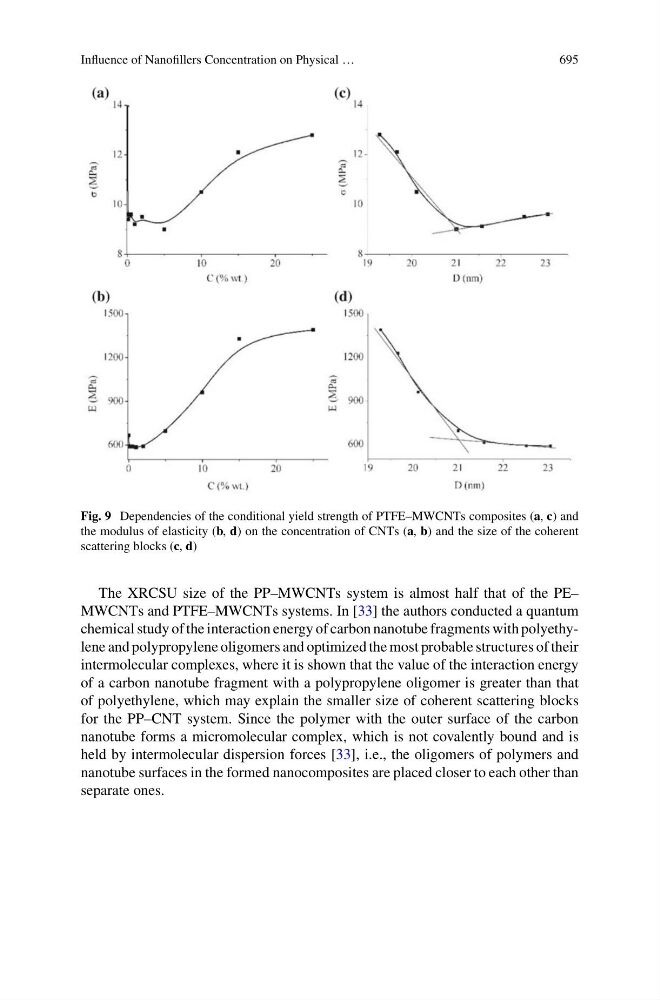
Fig. 9 Dependencies of the conditional yield strength of PTFE–MWCNTs composites (a, c) and
the modulus of elasticity (b, d) on the concentration of CNTs (a, b) and the size of the coherent
scattering blocks (c, d)
The XRCSU size of the PP–MWCNTs system is almost half that of the PE–
MWCNTs and PTFE–MWCNTs systems. In [33] the authors conducted a quantum
chemical study of the interaction energy of carbon nanotube fragments with polyethylene and polypropylene oligomers and optimized the most probable structures of their
intermolecular complexes, where it is shown that the value of the interaction energy
of a carbon nanotube fragment with a polypropylene oligomer is greater than that
of polyethylene, which may explain the smaller size of coherent scattering blocks
for the PP–CNT system. Since the polymer with the outer surface of the carbon
nanotube forms a micromolecular complex, which is not covalently bound and is
held by intermolecular dispersion forces [33], i.e., the oligomers of polymers and
nanotube surfaces in the formed nanocomposites are placed closer to each other than
separate ones.