

694
K. Ivanenko et al.
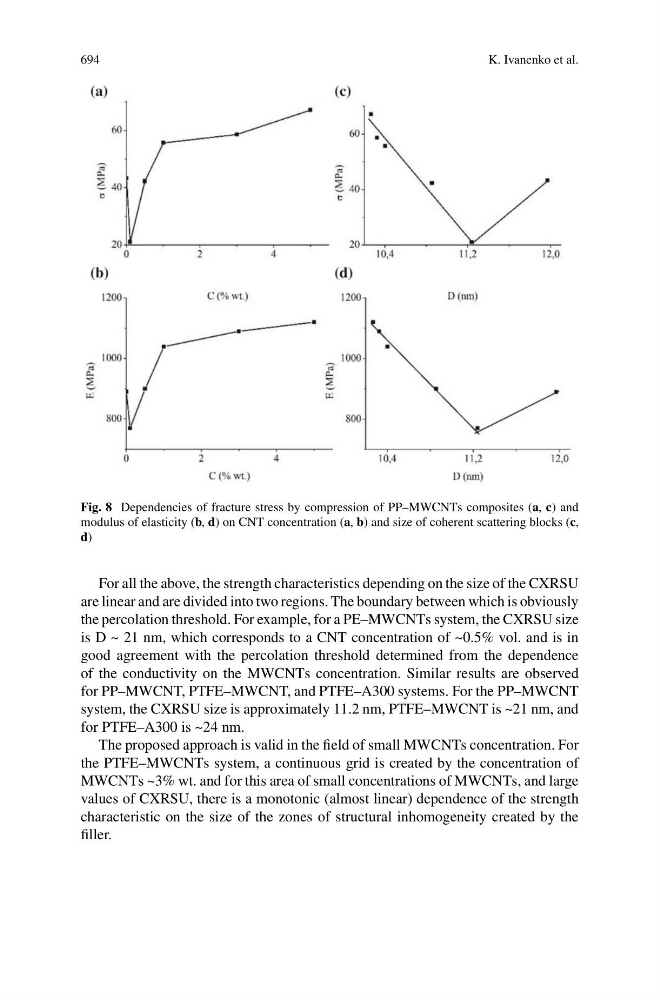
Fig. 8 Dependencies of fracture stress by compression of PP–MWCNTs composites (a, c) and
modulus of elasticity (b, d) on CNT concentration (a, b) and size of coherent scattering blocks (c,
d)
For all the above, the strength characteristics depending on the size of the CXRSU
are linear and are divided into two regions. The boundary between which is obviously
the percolation threshold. For example, for a PE–MWCNTs system, the CXRSU size
is D ~ 21 nm, which corresponds to a CNT concentration of ~0.5% vol. and is in
good agreement with the percolation threshold determined from the dependence
of the conductivity on the MWCNTs concentration. Similar results are observed
for PP–MWCNT, PTFE–MWCNT, and PTFE–A300 systems. For the PP–MWCNT
system, the CXRSU size is approximately 11.2 nm, PTFE–MWCNT is ~21 nm, and
for PTFE–A300 is ~24 nm.
The proposed approach is valid in the field of small MWCNTs concentration. For
the PTFE–MWCNTs system, a continuous grid is created by the concentration of
MWCNTs ~3% wt. and for this area of small concentrations of MWCNTs, and large
values of CXRSU, there is a monotonic (almost linear) dependence of the strength
characteristic on the size of the zones of structural inhomogeneity created by the
filler.