

Influence of Nanofillers Concentration on Physical …
693
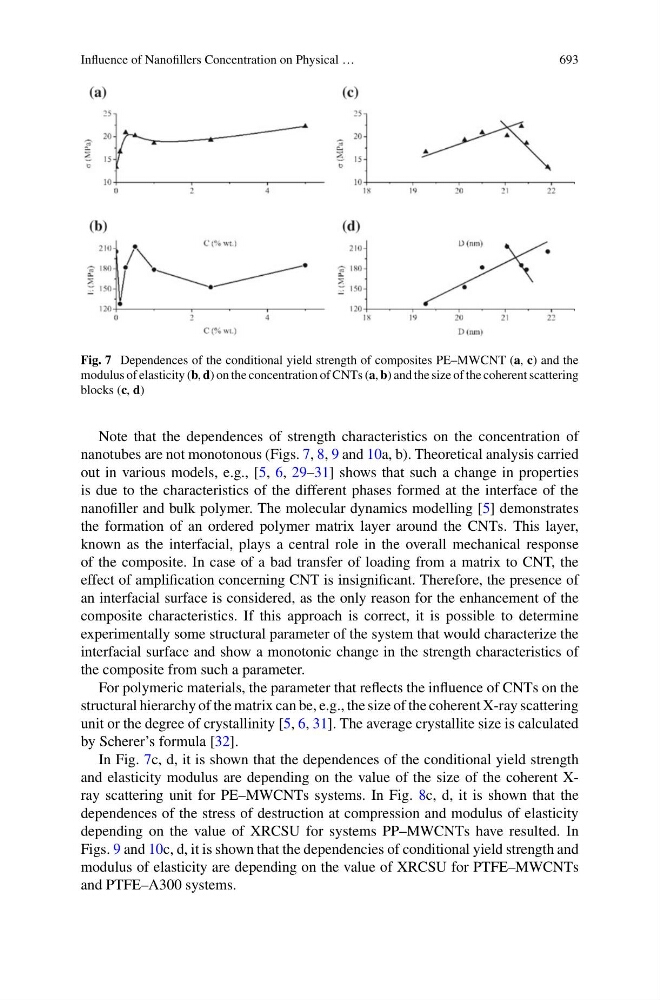
Fig. 7 Dependences of the conditional yield strength of composites PE–MWCNT (a, c) and the
modulus of elasticity (b, d) on the concentration of CNTs (a, b) and the size of the coherent scattering
blocks (c, d)
Note that the dependences of strength characteristics on the concentration of
nanotubes are not monotonous (Figs. 7, 8, 9 and 10a, b). Theoretical analysis carried
out in various models, e.g., [5, 6, 29–31] shows that such a change in properties
is due to the characteristics of the different phases formed at the interface of the
nanofiller and bulk polymer. The molecular dynamics modelling [5] demonstrates
the formation of an ordered polymer matrix layer around the CNTs. This layer,
known as the interfacial, plays a central role in the overall mechanical response
of the composite. In case of a bad transfer of loading from a matrix to CNT, the
effect of amplification concerning CNT is insignificant. Therefore, the presence of
an interfacial surface is considered, as the only reason for the enhancement of the
composite characteristics. If this approach is correct, it is possible to determine
experimentally some structural parameter of the system that would characterize the
interfacial surface and show a monotonic change in the strength characteristics of
the composite from such a parameter.
For polymeric materials, the parameter that reflects the influence of CNTs on the
structural hierarchy of the matrix can be, e.g., the size of the coherent X-ray scattering
unit or the degree of crystallinity [5, 6, 31]. The average crystallite size is calculated
by Scherer’s formula [32].
In Fig. 7c, d, it is shown that the dependences of the conditional yield strength
and elasticity modulus are depending on the value of the size of the coherent Xray scattering unit for PE–MWCNTs systems. In Fig. 8c, d, it is shown that the
dependences of the stress of destruction at compression and modulus of elasticity
depending on the value of XRCSU for systems PP–MWCNTs have resulted. In
Figs. 9 and 10c, d, it is shown that the dependencies of conditional yield strength and
modulus of elasticity are depending on the value of XRCSU for PTFE–MWCNTs
and PTFE–A300 systems.