

696
K. Ivanenko et al.
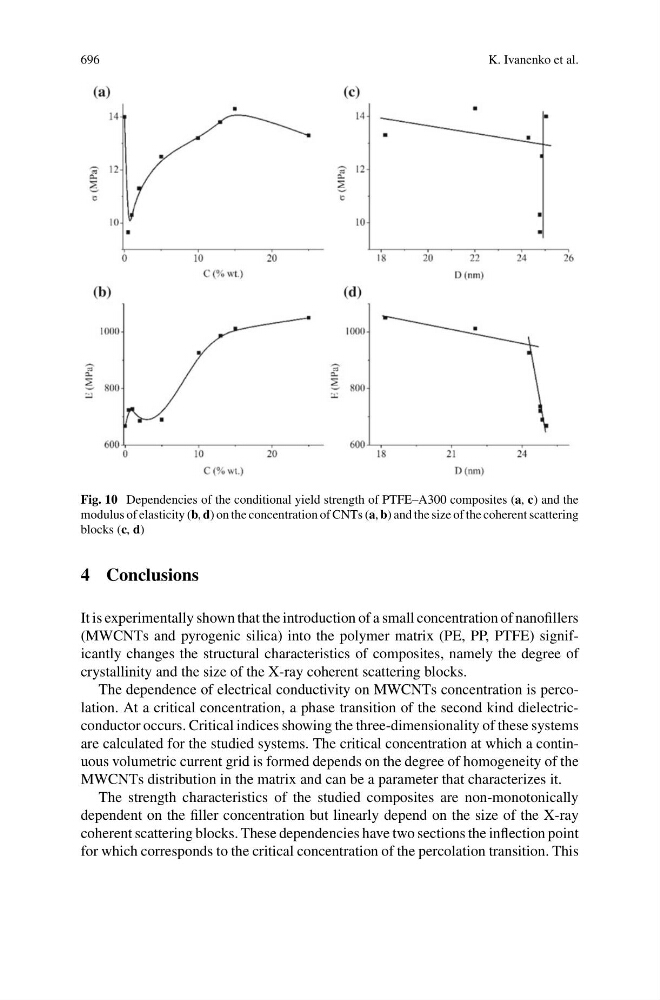
Fig. 10 Dependencies of the conditional yield strength of PTFE–A300 composites (a, c) and the
modulus of elasticity (b, d) on the concentration of CNTs (a, b) and the size of the coherent scattering
blocks (c, d)
4 Conclusions
It is experimentally shown that the introduction of a small concentration of nanofillers
(MWCNTs and pyrogenic silica) into the polymer matrix (PE, PP, PTFE) significantly changes the structural characteristics of composites, namely the degree of
crystallinity and the size of the X-ray coherent scattering blocks.
The dependence of electrical conductivity on MWCNTs concentration is percolation. At a critical concentration, a phase transition of the second kind dielectricconductor occurs. Critical indices showing the three-dimensionality of these systems
are calculated for the studied systems. The critical concentration at which a continuous volumetric current grid is formed depends on the degree of homogeneity of the
MWCNTs distribution in the matrix and can be a parameter that characterizes it.
The strength characteristics of the studied composites are non-monotonically
dependent on the filler concentration but linearly depend on the size of the X-ray
coherent scattering blocks. These dependencies have two sections the inflection point
for which corresponds to the critical concentration of the percolation transition. This