

Influence of Nanofillers Concentration on Physical …
689
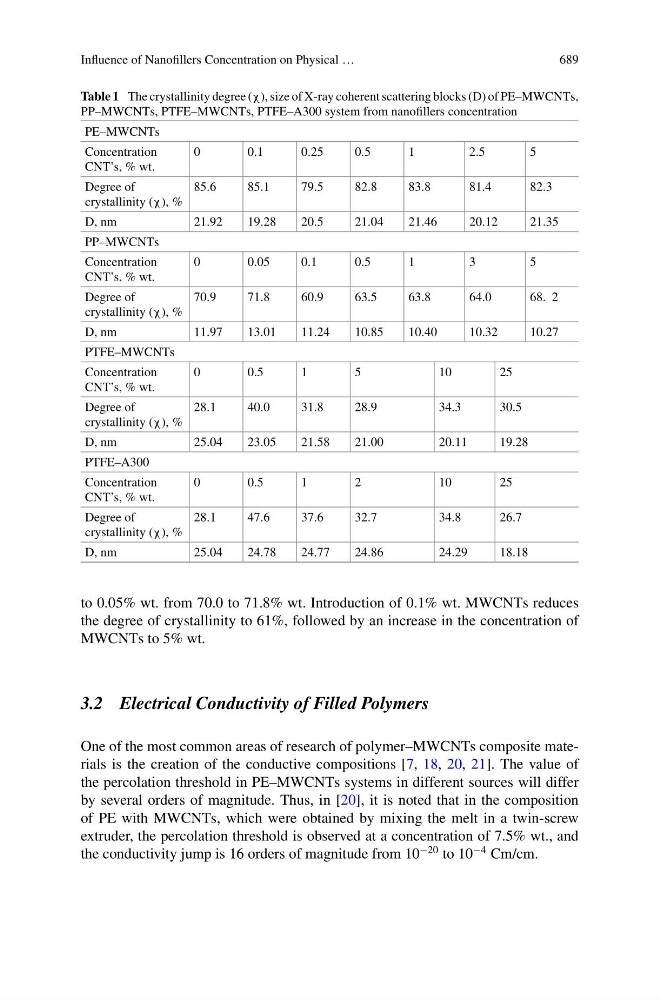
Table 1 The crystallinity degree (χ), size of X-ray coherent scattering blocks (D) of PE–MWCNTs,
PP–MWCNTs, PTFE–MWCNTs, PTFE–A300 system from nanofillers concentration
PE–MWCNTs
Concentration
CNT’s, % wt.
0
0.1
0.25
0.5
1
2.5
5
Degree of
crystallinity (χ), %
85.6
85.1
79.5
82.8
83.8
81.4
82.3
D, nm
21.92
19.28
20.5
21.04
21.46
20.12
21.35
PP–MWCNTs
Concentration
CNT’s, % wt.
0
0.05
0.1
0.5
1
3
5
Degree of
crystallinity (χ), %
70.9
71.8
60.9
63.5
63.8
64.0
68. 2
D, nm
11.97
13.01
11.24
10.85
10.40
10.32
10.27
PTFE–MWCNTs
Concentration
CNT’s, % wt.
0
0.5
1
5
10
25
Degree of
crystallinity (χ), %
28.1
40.0
31.8
28.9
34.3
30.5
D, nm
25.04
23.05
21.58
21.00
20.11
19.28
PTFE–A300
Concentration
CNT’s, % wt.
0
0.5
1
2
10
25
Degree of
crystallinity (χ), %
28.1
47.6
37.6
32.7
34.8
26.7
D, nm
25.04
24.78
24.77
24.86
24.29
18.18
to 0.05% wt. from 70.0 to 71.8% wt. Introduction of 0.1% wt. MWCNTs reduces
the degree of crystallinity to 61%, followed by an increase in the concentration of
MWCNTs to 5% wt.
3.2 Electrical Conductivity of Filled Polymers
One of the most common areas of research of polymer–MWCNTs composite materials is the creation of the conductive compositions [7, 18, 20, 21]. The value of
the percolation threshold in PE–MWCNTs systems in different sources will differ
by several orders of magnitude. Thus, in [20], it is noted that in the composition
of PE with MWCNTs, which were obtained by mixing the melt in a twin-screw
extruder, the percolation threshold is observed at a concentration of 7.5% wt., and
the conductivity jump is 16 orders of magnitude from 10
−20 to 10
−4 Cm/cm.