

688
K. Ivanenko et al.
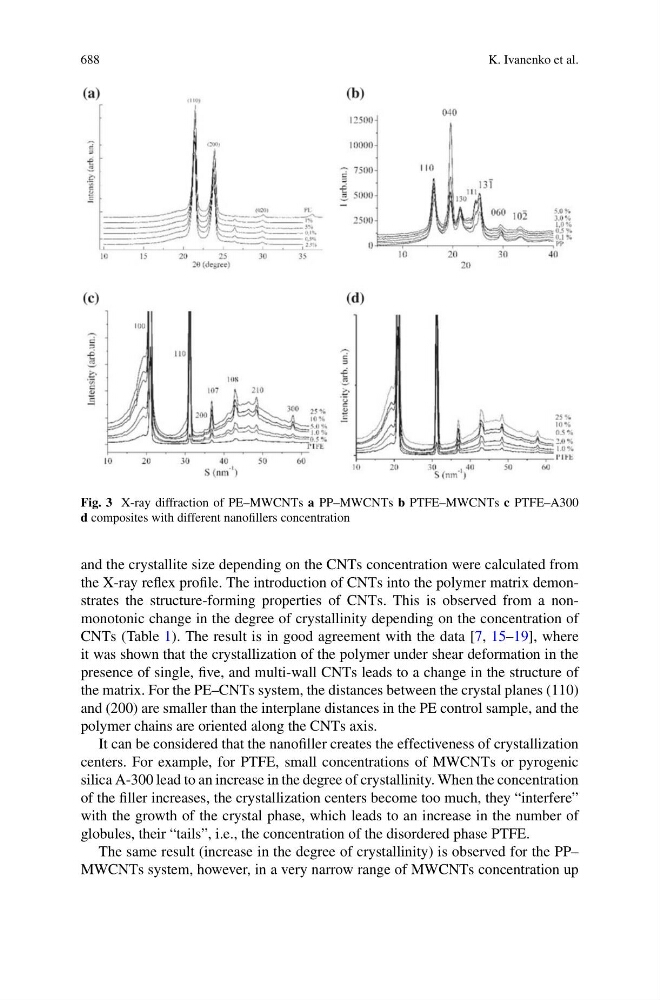
Fig. 3 X-ray diffraction of PE–MWCNTs a PP–MWCNTs b PTFE–MWCNTs c PTFE–A300
d composites with different nanofillers concentration
and the crystallite size depending on the CNTs concentration were calculated from
the X-ray reflex profile. The introduction of CNTs into the polymer matrix demonstrates the structure-forming properties of CNTs. This is observed from a nonmonotonic change in the degree of crystallinity depending on the concentration of
CNTs (Table 1). The result is in good agreement with the data [7, 15–19], where
it was shown that the crystallization of the polymer under shear deformation in the
presence of single, five, and multi-wall CNTs leads to a change in the structure of
the matrix. For the PE–CNTs system, the distances between the crystal planes (110)
and (200) are smaller than the interplane distances in the PE control sample, and the
polymer chains are oriented along the CNTs axis.
It can be considered that the nanofiller creates the effectiveness of crystallization
centers. For example, for PTFE, small concentrations of MWCNTs or pyrogenic
silica A-300 lead to an increase in the degree of crystallinity. When the concentration
of the filler increases, the crystallization centers become too much, they “interfere”
with the growth of the crystal phase, which leads to an increase in the number of
globules, their “tails”, i.e., the concentration of the disordered phase PTFE.
The same result (increase in the degree of crystallinity) is observed for the PP–
MWCNTs system, however, in a very narrow range of MWCNTs concentration up