

Influence of Nanofillers Concentration on Physical …
687
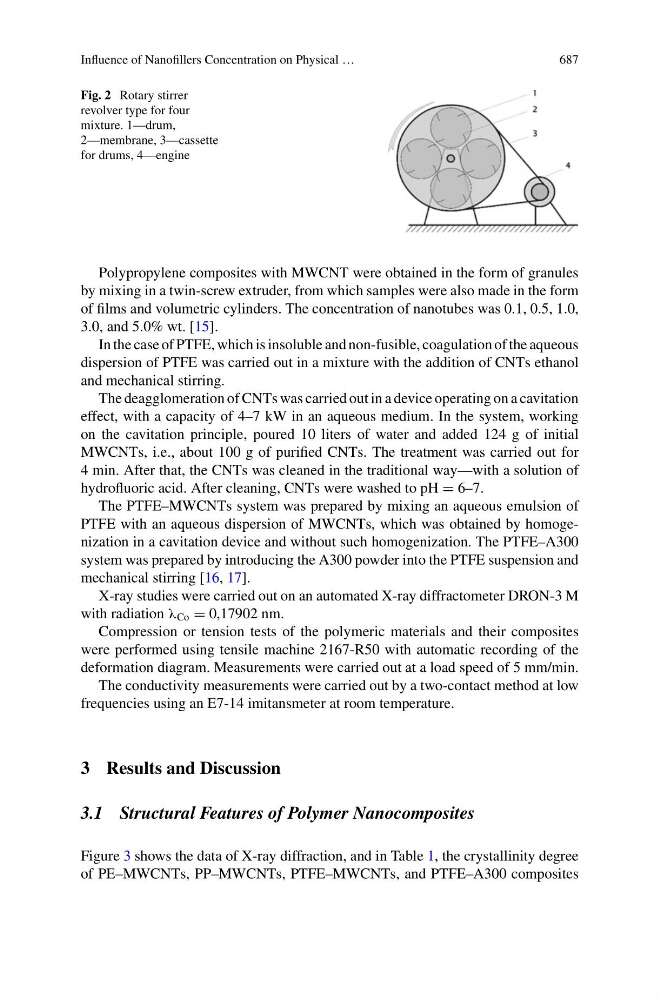
Fig. 2 Rotary stirrer
revolver type for four
mixture. 1—drum,
2—membrane, 3—cassette
for drums, 4—engine
Polypropylene composites with MWCNT were obtained in the form of granules
by mixing in a twin-screw extruder, from which samples were also made in the form
of films and volumetric cylinders. The concentration of nanotubes was 0.1, 0.5, 1.0,
3.0, and 5.0% wt. [15].
In the case of PTFE, which is insoluble and non-fusible, coagulation of the aqueous
dispersion of PTFE was carried out in a mixture with the addition of CNTs ethanol
and mechanical stirring.
The deagglomeration of CNTs was carried out in a device operating on a cavitation
effect, with a capacity of 4–7 kW in an aqueous medium. In the system, working
on the cavitation principle, poured 10 liters of water and added 124 g of initial
MWCNTs, i.e., about 100 g of purified CNTs. The treatment was carried out for
4 min. After that, the CNTs was cleaned in the traditional way—with a solution of
hydrofluoric acid. After cleaning, CNTs were washed to pH = 6–7.
The PTFE–MWCNTs system was prepared by mixing an aqueous emulsion of
PTFE with an aqueous dispersion of MWCNTs, which was obtained by homogenization in a cavitation device and without such homogenization. The PTFE–A300
system was prepared by introducing the A300 powder into the PTFE suspension and
mechanical stirring [16, 17].
X-ray studies were carried out on an automated X-ray diffractometer DRON-3 M
with radiation λ Co = 0,17902 nm.
Compression or tension tests of the polymeric materials and their composites
were performed using tensile machine 2167-R50 with automatic recording of the
deformation diagram. Measurements were carried out at a load speed of 5 mm/min.
The conductivity measurements were carried out by a two-contact method at low
frequencies using an E7-14 imitansmeter at room temperature.
3 Results and Discussion
3.1 Structural Features of Polymer Nanocomposites
Figure 3 shows the data of X-ray diffraction, and in Table 1, the crystallinity degree
of PE–MWCNTs, PP–MWCNTs, PTFE–MWCNTs, and PTFE–A300 composites