

686
K. Ivanenko et al.
distribution in the polymer matrix, which is relevant to the efforts of many researchers
[1–4, 7–10]. The potential for CNT-filled polymers is much higher because they have
higher mechanical characteristics than unfilled material.
In this paper, the regularities of the influence of carbon nanotubes are considered
and another nanoscale system of pyrogenic silica A-300 on the electrical and mechanical characteristics of a composite material based on polymers: polyethylene (PE),
polypropylene (PP), and polytetrafluoroethylene (PTFE) is selected for comparison.
2 Methods
Low-density PE and FP as matrixes and MWCNTs and ground EG as fillers
were chosen for preparation of NCM samples for testing. The multi-walled carbon
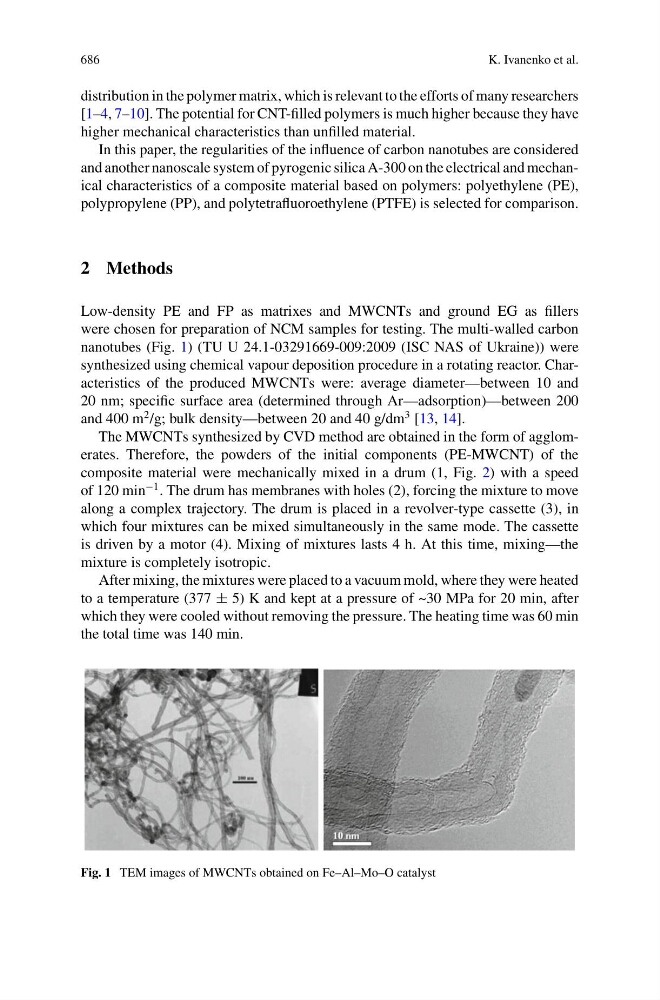
nanotubes (Fig. 1) (TU U 24.1-03291669-009:2009 (ISC NAS of Ukraine)) were
synthesized using chemical vapour deposition procedure in a rotating reactor. Characteristics of the produced MWCNTs were: average diameter—between 10 and
20 nm; specific surface area (determined through Ar—adsorption)—between 200
and 400 m
2 /g; bulk density—between 20 and 40 g/dm
3 [13, 14].
The MWCNTs synthesized by CVD method are obtained in the form of agglomerates. Therefore, the powders of the initial components (PE-MWCNT) of the
composite material were mechanically mixed in a drum (1, Fig. 2) with a speed
of 120 min
−1 . The drum has membranes with holes (2), forcing the mixture to move
along a complex trajectory. The drum is placed in a revolver-type cassette (3), in
which four mixtures can be mixed simultaneously in the same mode. The cassette
is driven by a motor (4). Mixing of mixtures lasts 4 h. At this time, mixing—the
mixture is completely isotropic.
After mixing, the mixtures were placed to a vacuum mold, where they were heated
to a temperature (377 ± 5) K and kept at a pressure of ~30 MPa for 20 min, after
which they were cooled without removing the pressure. The heating time was 60 min
the total time was 140 min.
Fig. 1 TEM images of MWCNTs obtained on Fe–Al–Mo–O catalyst