

652
M. C. Bouleklab et al.
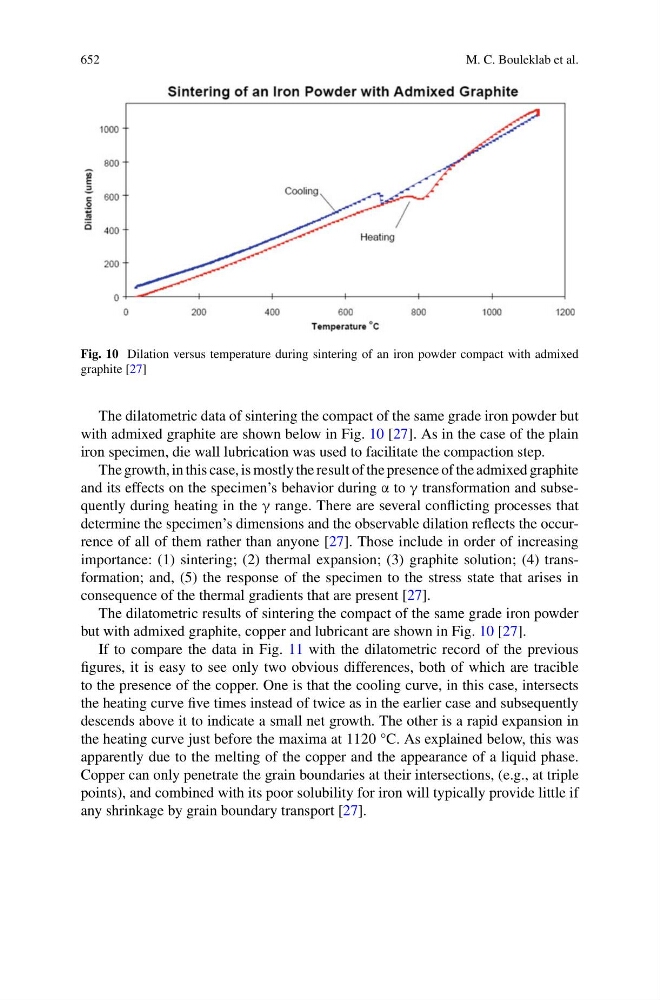
Fig. 10 Dilation versus temperature during sintering of an iron powder compact with admixed
graphite [27]
The dilatometric data of sintering the compact of the same grade iron powder but
with admixed graphite are shown below in Fig. 10 [27]. As in the case of the plain
iron specimen, die wall lubrication was used to facilitate the compaction step.
The growth, in this case, is mostly the result of the presence of the admixed graphite
and its effects on the specimen’s behavior during α to γ transformation and subsequently during heating in the γ range. There are several conflicting processes that
determine the specimen’s dimensions and the observable dilation reflects the occurrence of all of them rather than anyone [27]. Those include in order of increasing
importance: (1) sintering; (2) thermal expansion; (3) graphite solution; (4) transformation; and, (5) the response of the specimen to the stress state that arises in
consequence of the thermal gradients that are present [27].
The dilatometric results of sintering the compact of the same grade iron powder
but with admixed graphite, copper and lubricant are shown in Fig. 10 [27].
If to compare the data in Fig. 11 with the dilatometric record of the previous
figures, it is easy to see only two obvious differences, both of which are tracible
to the presence of the copper. One is that the cooling curve, in this case, intersects
the heating curve five times instead of twice as in the earlier case and subsequently
descends above it to indicate a small net growth. The other is a rapid expansion in
the heating curve just before the maxima at 1120 °C. As explained below, this was
apparently due to the melting of the copper and the appearance of a liquid phase.
Copper can only penetrate the grain boundaries at their intersections, (e.g., at triple
points), and combined with its poor solubility for iron will typically provide little if
any shrinkage by grain boundary transport [27].