

Influence of the Carbon Allotropes on Dilatometric Properties …
653
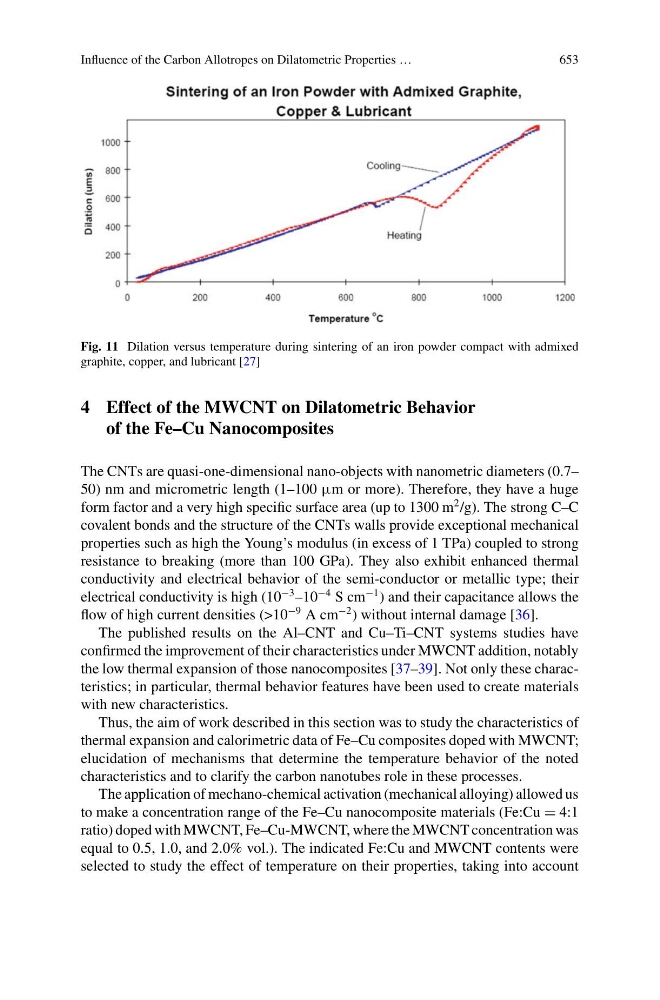
Fig. 11 Dilation versus temperature during sintering of an iron powder compact with admixed
graphite, copper, and lubricant [27]
4 Effect of the MWCNT on Dilatometric Behavior
of the Fe–Cu Nanocomposites
The CNTs are quasi-one-dimensional nano-objects with nanometric diameters (0.7–
50) nm and micrometric length (1–100 μm or more). Therefore, they have a huge
form factor and a very high specific surface area (up to 1300 m
2 /g). The strong C–C
covalent bonds and the structure of the CNTs walls provide exceptional mechanical
properties such as high the Young’s modulus (in excess of 1 TPa) coupled to strong
resistance to breaking (more than 100 GPa). They also exhibit enhanced thermal
conductivity and electrical behavior of the semi-conductor or metallic type; their
electrical conductivity is high (10
−3 –10
−4 S cm
−1 ) and their capacitance allows the
flow of high current densities (>10
−9 A cm
−2 ) without internal damage [36].
The published results on the Al–CNT and Cu–Ti–CNT systems studies have
confirmed the improvement of their characteristics under MWCNT addition, notably
the low thermal expansion of those nanocomposites [37–39]. Not only these characteristics; in particular, thermal behavior features have been used to create materials
with new characteristics.
Thus, the aim of work described in this section was to study the characteristics of
thermal expansion and calorimetric data of Fe–Cu composites doped with MWCNT;
elucidation of mechanisms that determine the temperature behavior of the noted
characteristics and to clarify the carbon nanotubes role in these processes.
The application of mechano-chemical activation (mechanical alloying) allowed us
to make a concentration range of the Fe–Cu nanocomposite materials (Fe:Cu = 4:1
ratio) doped with MWCNT, Fe–Cu-MWCNT, where the MWCNT concentration was
equal to 0.5, 1.0, and 2.0% vol.). The indicated Fe:Cu and MWCNT contents were
selected to study the effect of temperature on their properties, taking into account