

Influence of the Carbon Allotropes on Dilatometric Properties …
651
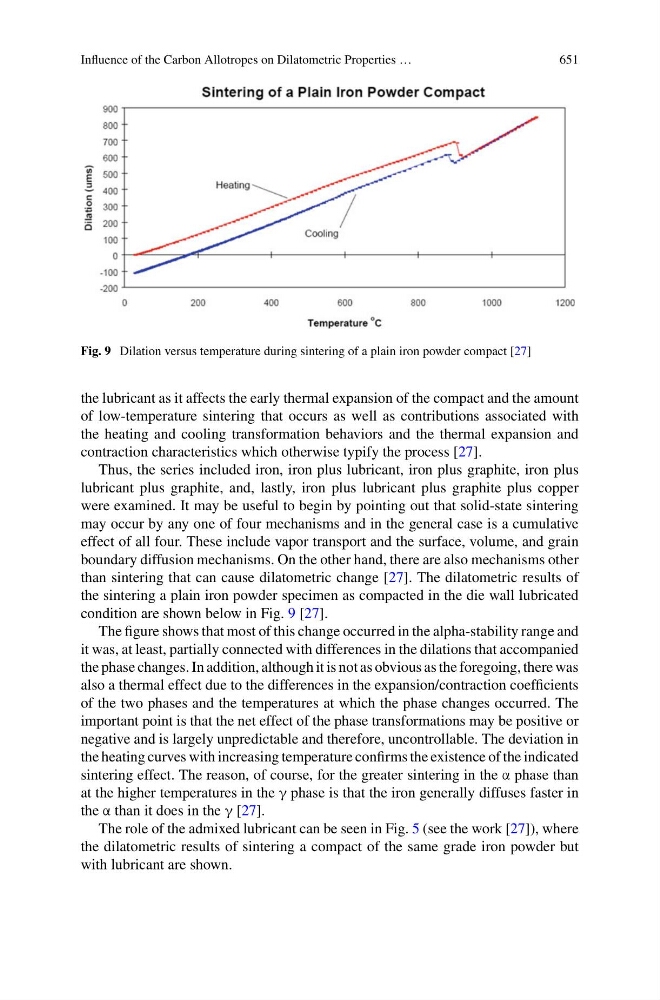
Fig. 9 Dilation versus temperature during sintering of a plain iron powder compact [27]
the lubricant as it affects the early thermal expansion of the compact and the amount
of low-temperature sintering that occurs as well as contributions associated with
the heating and cooling transformation behaviors and the thermal expansion and
contraction characteristics which otherwise typify the process [27].
Thus, the series included iron, iron plus lubricant, iron plus graphite, iron plus
lubricant plus graphite, and, lastly, iron plus lubricant plus graphite plus copper
were examined. It may be useful to begin by pointing out that solid-state sintering
may occur by any one of four mechanisms and in the general case is a cumulative
effect of all four. These include vapor transport and the surface, volume, and grain
boundary diffusion mechanisms. On the other hand, there are also mechanisms other
than sintering that can cause dilatometric change [27]. The dilatometric results of
the sintering a plain iron powder specimen as compacted in the die wall lubricated
condition are shown below in Fig. 9 [27].
The figure shows that most of this change occurred in the alpha-stability range and
it was, at least, partially connected with differences in the dilations that accompanied
the phase changes. In addition, although it is not as obvious as the foregoing, there was
also a thermal effect due to the differences in the expansion/contraction coefficients
of the two phases and the temperatures at which the phase changes occurred. The
important point is that the net effect of the phase transformations may be positive or
negative and is largely unpredictable and therefore, uncontrollable. The deviation in
the heating curves with increasing temperature confirms the existence of the indicated
sintering effect. The reason, of course, for the greater sintering in the α phase than
at the higher temperatures in the γ phase is that the iron generally diffuses faster in
the α than it does in the γ [27].
The role of the admixed lubricant can be seen in Fig. 5 (see the work [27]), where
the dilatometric results of sintering a compact of the same grade iron powder but
with lubricant are shown.