

Influence of the Carbon Allotropes on Dilatometric Properties …
649
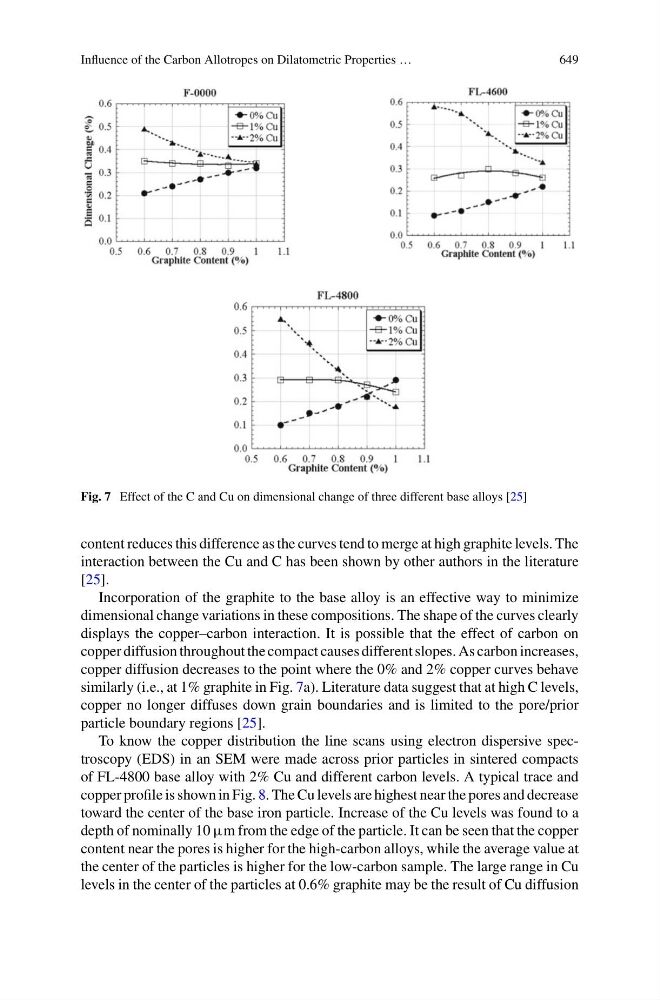
Fig. 7 Effect of the C and Cu on dimensional change of three different base alloys [25]
content reduces this difference as the curves tend to merge at high graphite levels. The
interaction between the Cu and C has been shown by other authors in the literature
[25].
Incorporation of the graphite to the base alloy is an effective way to minimize
dimensional change variations in these compositions. The shape of the curves clearly
displays the copper–carbon interaction. It is possible that the effect of carbon on
copper diffusion throughout the compact causes different slopes. As carbon increases,
copper diffusion decreases to the point where the 0% and 2% copper curves behave
similarly (i.e., at 1% graphite in Fig. 7a). Literature data suggest that at high C levels,
copper no longer diffuses down grain boundaries and is limited to the pore/prior
particle boundary regions [25].
To know the copper distribution the line scans using electron dispersive spectroscopy (EDS) in an SEM were made across prior particles in sintered compacts
of FL-4800 base alloy with 2% Cu and different carbon levels. A typical trace and
copper profile is shown in Fig. 8. The Cu levels are highest near the pores and decrease
toward the center of the base iron particle. Increase of the Cu levels was found to a
depth of nominally 10 μm from the edge of the particle. It can be seen that the copper
content near the pores is higher for the high-carbon alloys, while the average value at
the center of the particles is higher for the low-carbon sample. The large range in Cu
levels in the center of the particles at 0.6% graphite may be the result of Cu diffusion