

648
M. C. Bouleklab et al.
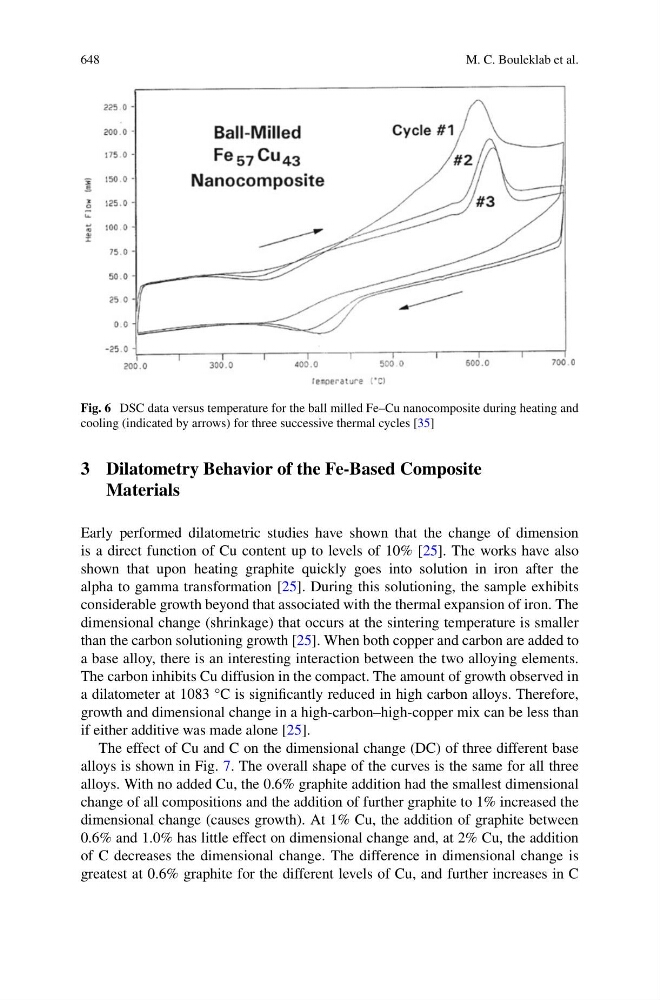
Fig. 6 DSC data versus temperature for the ball milled Fe–Cu nanocomposite during heating and
cooling (indicated by arrows) for three successive thermal cycles [35]
3 Dilatometry Behavior of the Fe-Based Composite
Materials
Early performed dilatometric studies have shown that the change of dimension
is a direct function of Cu content up to levels of 10% [25]. The works have also
shown that upon heating graphite quickly goes into solution in iron after the
alpha to gamma transformation [25]. During this solutioning, the sample exhibits
considerable growth beyond that associated with the thermal expansion of iron. The
dimensional change (shrinkage) that occurs at the sintering temperature is smaller
than the carbon solutioning growth [25]. When both copper and carbon are added to
a base alloy, there is an interesting interaction between the two alloying elements.
The carbon inhibits Cu diffusion in the compact. The amount of growth observed in
a dilatometer at 1083 °C is significantly reduced in high carbon alloys. Therefore,
growth and dimensional change in a high-carbon–high-copper mix can be less than
if either additive was made alone [25].
The effect of Cu and C on the dimensional change (DC) of three different base
alloys is shown in Fig. 7. The overall shape of the curves is the same for all three
alloys. With no added Cu, the 0.6% graphite addition had the smallest dimensional
change of all compositions and the addition of further graphite to 1% increased the
dimensional change (causes growth). At 1% Cu, the addition of graphite between
0.6% and 1.0% has little effect on dimensional change and, at 2% Cu, the addition
of C decreases the dimensional change. The difference in dimensional change is
greatest at 0.6% graphite for the different levels of Cu, and further increases in C