

Influence of the Carbon Allotropes on Dilatometric Properties …
645
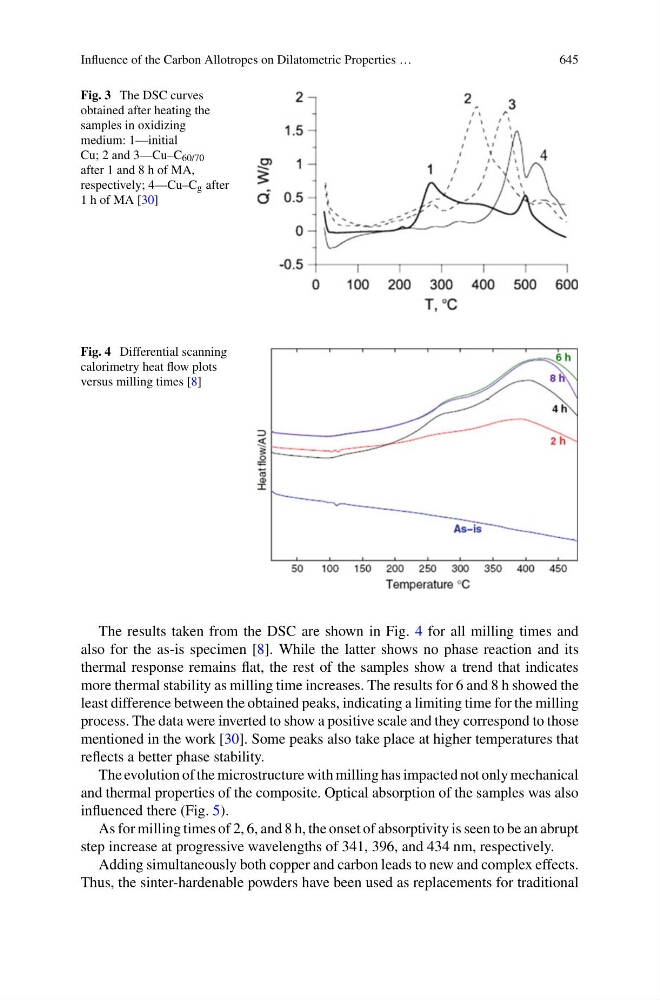
Fig. 3 The DSC curves
obtained after heating the
samples in oxidizing
medium: 1—initial
Cu; 2 and 3—Cu–C 60/70
after 1 and 8 h of MA,
respectively; 4—Cu–C g after
1 h of MA [30]
Fig. 4 Differential scanning
calorimetry heat flow plots
versus milling times [8]
The results taken from the DSC are shown in Fig. 4 for all milling times and
also for the as-is specimen [8]. While the latter shows no phase reaction and its
thermal response remains flat, the rest of the samples show a trend that indicates
more thermal stability as milling time increases. The results for 6 and 8 h showed the
least difference between the obtained peaks, indicating a limiting time for the milling
process. The data were inverted to show a positive scale and they correspond to those
mentioned in the work [30]. Some peaks also take place at higher temperatures that
reflects a better phase stability.
The evolution of the microstructure with milling has impacted not only mechanical
and thermal properties of the composite. Optical absorption of the samples was also
influenced there (Fig. 5).
As for milling times of 2, 6, and 8 h, the onset of absorptivity is seen to be an abrupt
step increase at progressive wavelengths of 341, 396, and 434 nm, respectively.
Adding simultaneously both copper and carbon leads to new and complex effects.
Thus, the sinter-hardenable powders have been used as replacements for traditional