

646
M. C. Bouleklab et al.
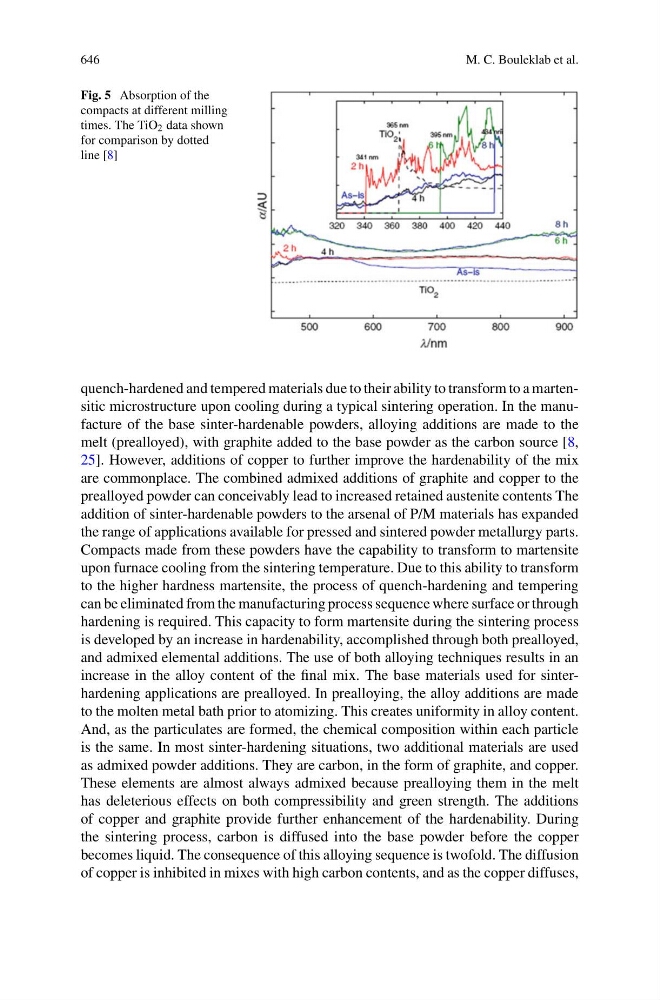
Fig. 5 Absorption of the
compacts at different milling
times. The TiO 2 data shown
for comparison by dotted
line [8]
quench-hardened and tempered materials due to their ability to transform to a martensitic microstructure upon cooling during a typical sintering operation. In the manufacture of the base sinter-hardenable powders, alloying additions are made to the
melt (prealloyed), with graphite added to the base powder as the carbon source [8,
25]. However, additions of copper to further improve the hardenability of the mix
are commonplace. The combined admixed additions of graphite and copper to the
prealloyed powder can conceivably lead to increased retained austenite contents The
addition of sinter-hardenable powders to the arsenal of P/M materials has expanded
the range of applications available for pressed and sintered powder metallurgy parts.
Compacts made from these powders have the capability to transform to martensite
upon furnace cooling from the sintering temperature. Due to this ability to transform
to the higher hardness martensite, the process of quench-hardening and tempering
can be eliminated from the manufacturing process sequence where surface or through
hardening is required. This capacity to form martensite during the sintering process
is developed by an increase in hardenability, accomplished through both prealloyed,
and admixed elemental additions. The use of both alloying techniques results in an
increase in the alloy content of the final mix. The base materials used for sinterhardening applications are prealloyed. In prealloying, the alloy additions are made
to the molten metal bath prior to atomizing. This creates uniformity in alloy content.
And, as the particulates are formed, the chemical composition within each particle
is the same. In most sinter-hardening situations, two additional materials are used
as admixed powder additions. They are carbon, in the form of graphite, and copper.
These elements are almost always admixed because prealloying them in the melt
has deleterious effects on both compressibility and green strength. The additions
of copper and graphite provide further enhancement of the hardenability. During
the sintering process, carbon is diffused into the base powder before the copper
becomes liquid. The consequence of this alloying sequence is twofold. The diffusion
of copper is inhibited in mixes with high carbon contents, and as the copper diffuses,