

644
M. C. Bouleklab et al.
Fig. 1 Graphic abstract showing the content of the paper 30 [30]
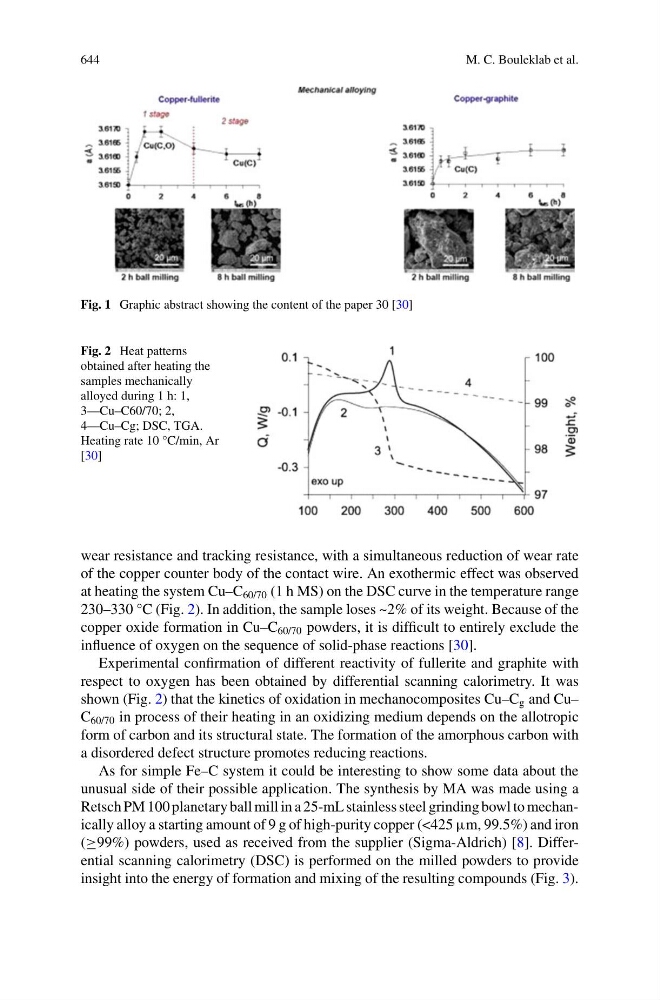
Fig. 2 Heat patterns
obtained after heating the
samples mechanically
alloyed during 1 h: 1,
3—Cu–C60/70; 2,
4—Cu–Cg; DSC, TGA.
Heating rate 10 °C/min, Ar
[30]
wear resistance and tracking resistance, with a simultaneous reduction of wear rate
of the copper counter body of the contact wire. An exothermic effect was observed
at heating the system Cu–C 60/70 (1 h MS) on the DSC curve in the temperature range
230–330 °C (Fig. 2). In addition, the sample loses ~2% of its weight. Because of the
copper oxide formation in Cu–C 60/70 powders, it is difficult to entirely exclude the
influence of oxygen on the sequence of solid-phase reactions [30].
Experimental confirmation of different reactivity of fullerite and graphite with
respect to oxygen has been obtained by differential scanning calorimetry. It was
shown (Fig. 2) that the kinetics of oxidation in mechanocomposites Cu–C g and Cu–
C 60/70 in process of their heating in an oxidizing medium depends on the allotropic
form of carbon and its structural state. The formation of the amorphous carbon with
a disordered defect structure promotes reducing reactions.
As for simple Fe–C system it could be interesting to show some data about the
unusual side of their possible application. The synthesis by MA was made using a
Retsch PM 100 planetary ball mill in a 25-mL stainless steel grinding bowl to mechanically alloy a starting amount of 9 g of high-purity copper (<425 μm, 99.5%) and iron
(≥99%) powders, used as received from the supplier (Sigma-Aldrich) [8]. Differential scanning calorimetry (DSC) is performed on the milled powders to provide
insight into the energy of formation and mixing of the resulting compounds (Fig. 3).