

600
A. V. Luzanov
a sharp contradiction with the main mechanisms in strongly correlated systems,
in particular with the key Mott localization caused by sufficiently strong electron
correlation. More than that, due to a general applicability of the Mott theory to
finite-sized conjugated systems with half-filled bands, it is natural to suggest that
conductance does not increase with length for any π -conjugated bipartite (alternant)
network.
Turn also attention to the most recent paper [50] where the specifically improved
TB scheme is proposed for computing molecular conductivity. This model is interesting per se, while the whole approach seems to be rather artificial from the viewpoint
of the conventional quantum chemistry. Indeed, the needed long-range interactions
elementarily follow from the usual PPP Fockian matrix, especially if computing the
Fockian with TB (Hückel) bond orders (e.g., in the form of f [1] from (9) as was
suggested in [19, 21]). Besides, π -electron correlation is a fundamental feature of
nanoscale systems, and it cannot be handled if dealing with any Hückel-like or even
RHF wave functions.
Appendices
Appendix A: Working Formulas for Green’s Functions
in Various π-Schemes
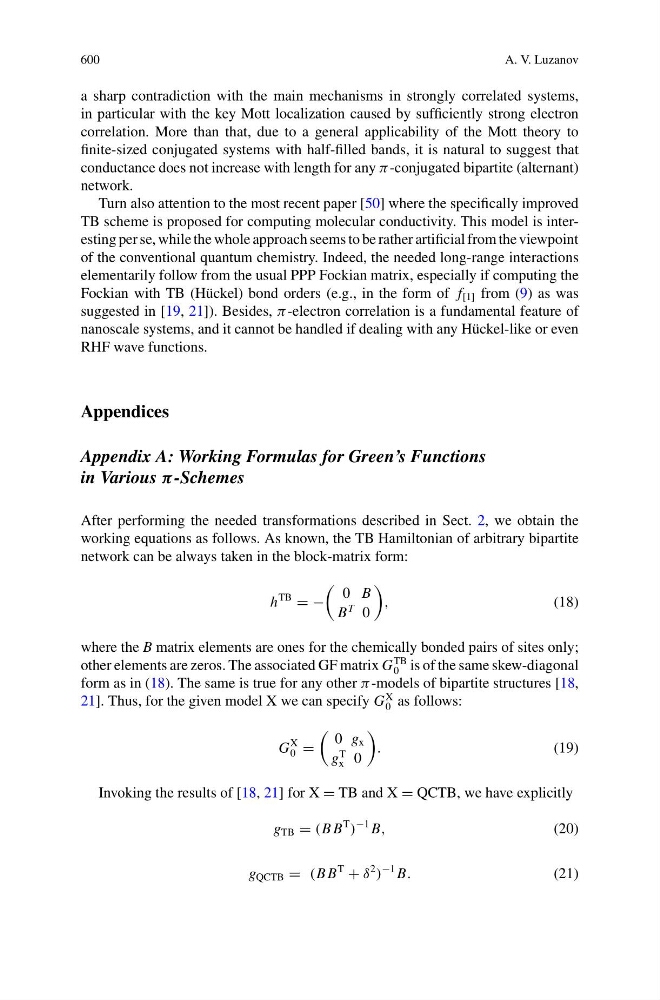
After performing the needed transformations described in Sect. 2, we obtain the
working equations as follows. As known, the TB Hamiltonian of arbitrary bipartite
network can be always taken in the block-matrix form:
h
TB
= −
0 B
B
T 0
,
(18)
where the B matrix elements are ones for the chemically bonded pairs of sites only;
other elements are zeros. The associated GF matrix G
TB
0 is of the same skew-diagonal
form as in (18). The same is true for any other π -models of bipartite structures [18,
21]. Thus, for the given model X we can specify G
X
0 as follows:
G
X
0 =
0 g x
g
T
x 0
.
(19)
Invoking the results of [18, 21] for X = TB and X = QCTB, we have explicitly
g TB = (B B
T
)
−1 B,
(20)
g QCTB = (B B
T
+ δ
2
)
−1 B.
(21)