

Conductance Length Dependence in Carbon-Conjugated Nanoscale Systems …
601
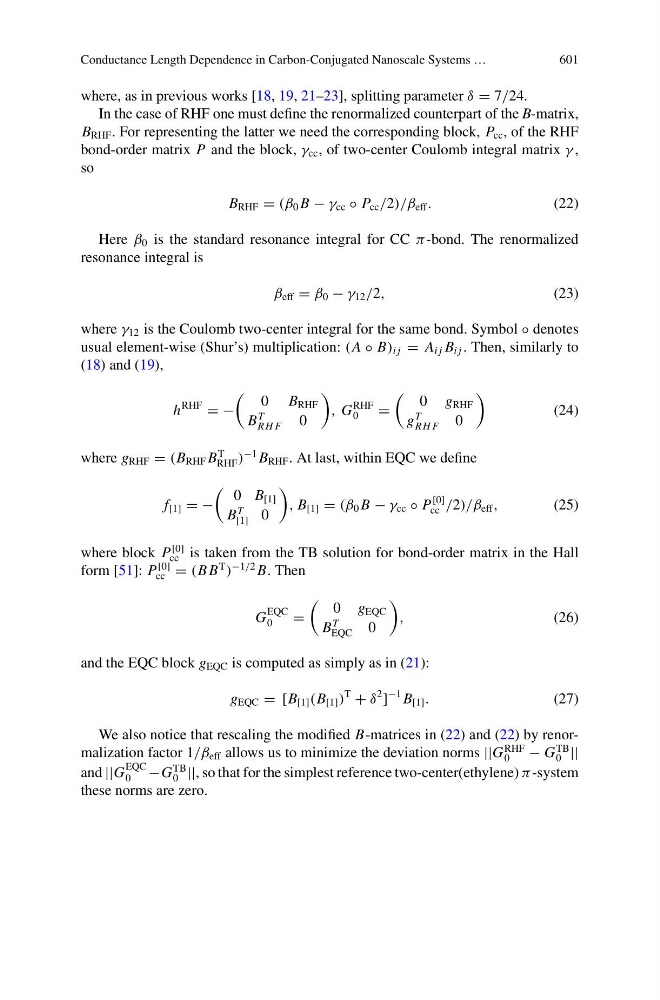
where, as in previous works [18, 19, 21–23], splitting parameter δ = 7/24.
In the case of RHF one must define the renormalized counterpart of the B-matrix,
B RHF . For representing the latter we need the corresponding block, P cc , of the RHF
bond-order matrix P and the block, γ cc , of two-center Coulomb integral matrix γ ,
so
B RHF = (β 0 B − γ cc ◦ P cc /2)/β eff .
(22)
Here β 0 is the standard resonance integral for CC π -bond. The renormalized
resonance integral is
β eff = β 0 − γ 12 /2,
(23)
where γ 12 is the Coulomb two-center integral for the same bond. Symbol ◦ denotes
usual element-wise (Shur’s) multiplication: (A ◦ B) i j = A i j B i j . Then, similarly to
(18) and (19),
h
RHF
= −
0 B RHF
B
T
R H F
0
, G
RHF
0
=
0 g RHF
g
T
R H F
0
(24)
where g RHF = (B RHF B
T
RHF )
−1 B RHF . At last, within EQC we define
f [1] = −
0 B [1]
B
T
[1] 0
, B [1] = (β 0 B − γ cc ◦ P
[0]
cc /2)/β eff ,
(25)
where block P
[0]
cc is taken from the TB solution for bond-order matrix in the Hall
form [51]: P
[0]
cc = (B B
T
)
−1/2 B. Then
G
EQC
0
=
0 g EQC
B
T
EQC
0
,
(26)
and the EQC block g EQC is computed as simply as in (21):
g EQC = [B [1] (B [1] )
T
+ δ
2
]
−1 B [1] .
(27)
We also notice that rescaling the modified B-matrices in (22) and (22) by renormalization factor 1/β eff allows us to minimize the deviation norms ||G
RHF
0
− G
TB
0 ||
and ||G
EQC
0
−G
TB
0 ||, so that for the simplest reference two-center(ethylene) π -system
these norms are zero.