

Conductance Length Dependence in Carbon-Conjugated Nanoscale Systems …
599
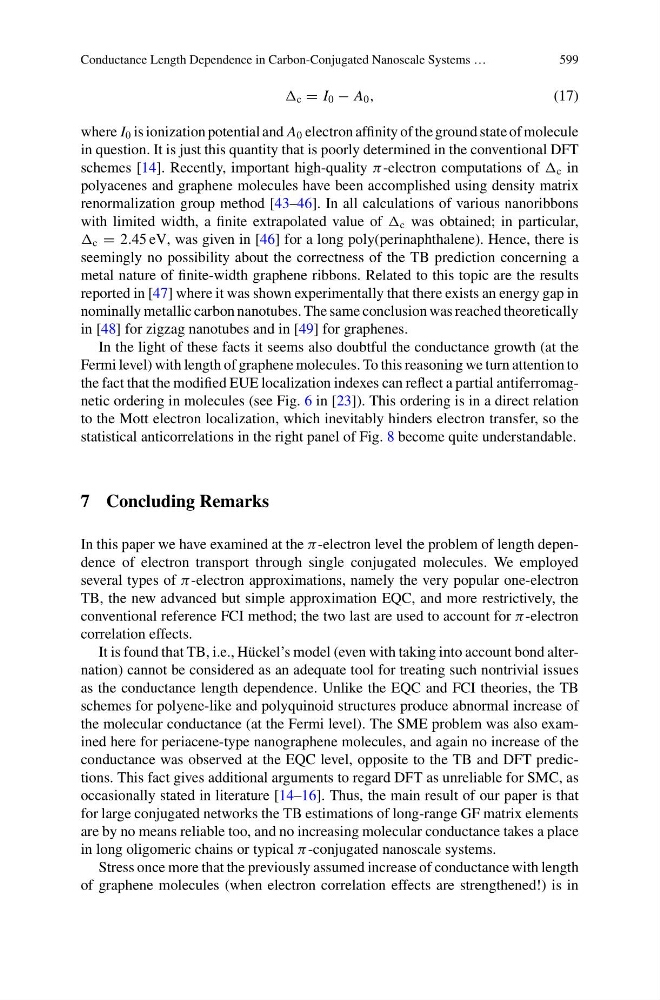
c = I 0 − A 0 ,
(17)
where I 0 is ionization potential and A 0 electron affinity of the ground state of molecule
in question. It is just this quantity that is poorly determined in the conventional DFT
schemes [14]. Recently, important high-quality π -electron computations of c in
polyacenes and graphene molecules have been accomplished using density matrix
renormalization group method [43–46]. In all calculations of various nanoribbons
with limited width, a finite extrapolated value of c was obtained; in particular,
c = 2.45 eV, was given in [46] for a long poly(perinaphthalene). Hence, there is
seemingly no possibility about the correctness of the TB prediction concerning a
metal nature of finite-width graphene ribbons. Related to this topic are the results
reported in [47] where it was shown experimentally that there exists an energy gap in
nominally metallic carbon nanotubes. The same conclusion was reached theoretically
in [48] for zigzag nanotubes and in [49] for graphenes.
In the light of these facts it seems also doubtful the conductance growth (at the
Fermi level) with length of graphene molecules. To this reasoning we turn attention to
the fact that the modified EUE localization indexes can reflect a partial antiferromagnetic ordering in molecules (see Fig. 6 in [23]). This ordering is in a direct relation
to the Mott electron localization, which inevitably hinders electron transfer, so the
statistical anticorrelations in the right panel of Fig. 8 become quite understandable.
7 Concluding Remarks
In this paper we have examined at the π -electron level the problem of length dependence of electron transport through single conjugated molecules. We employed
several types of π -electron approximations, namely the very popular one-electron
TB, the new advanced but simple approximation EQC, and more restrictively, the
conventional reference FCI method; the two last are used to account for π -electron
correlation effects.
It is found that TB, i.e., Hückel’s model (even with taking into account bond alternation) cannot be considered as an adequate tool for treating such nontrivial issues
as the conductance length dependence. Unlike the EQC and FCI theories, the TB
schemes for polyene-like and polyquinoid structures produce abnormal increase of
the molecular conductance (at the Fermi level). The SME problem was also examined here for periacene-type nanographene molecules, and again no increase of the
conductance was observed at the EQC level, opposite to the TB and DFT predictions. This fact gives additional arguments to regard DFT as unreliable for SMC, as
occasionally stated in literature [14–16]. Thus, the main result of our paper is that
for large conjugated networks the TB estimations of long-range GF matrix elements
are by no means reliable too, and no increasing molecular conductance takes a place
in long oligomeric chains or typical π -conjugated nanoscale systems.
Stress once more that the previously assumed increase of conductance with length
of graphene molecules (when electron correlation effects are strengthened!) is in