

598
A. V. Luzanov
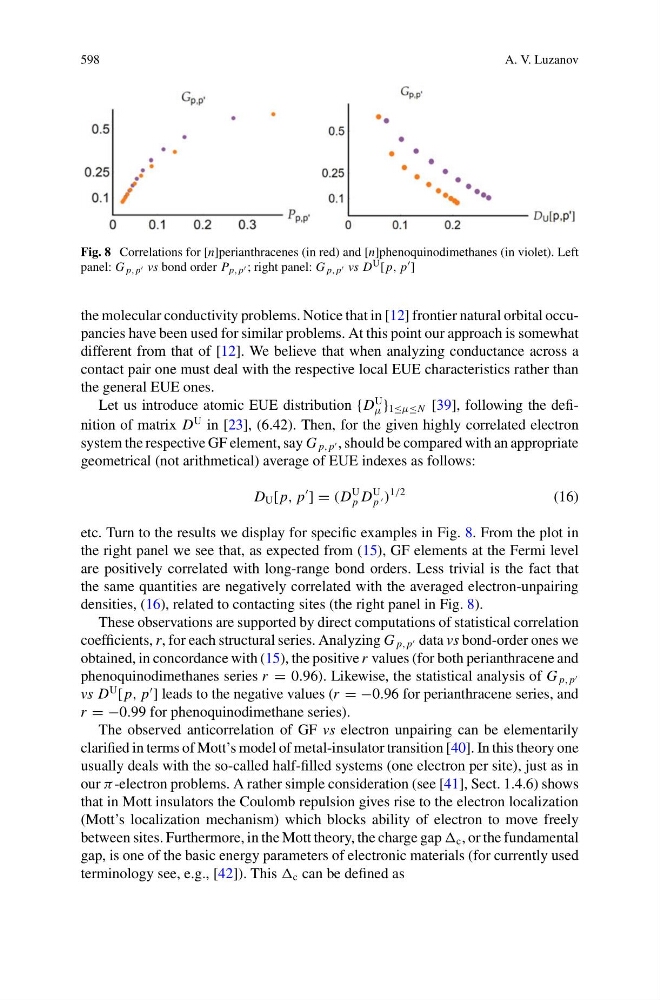
Fig. 8 Correlations for [n]perianthracenes (in red) and [n]phenoquinodimethanes (in violet). Left
panel: G p, p vs bond order P p, p ; right panel: G p, p vs D U [ p, p ]
the molecular conductivity problems. Notice that in [12] frontier natural orbital occupancies have been used for similar problems. At this point our approach is somewhat
different from that of [12]. We believe that when analyzing conductance across a
contact pair one must deal with the respective local EUE characteristics rather than
the general EUE ones.
Let us introduce atomic EUE distribution {D
U
μ } 1≤μ≤N [39], following the definition of matrix D
U in [23], (6.42). Then, for the given highly correlated electron
system the respective GF element, say G p, p , should be compared with an appropriate
geometrical (not arithmetical) average of EUE indexes as follows:
D U [ p, p
] = (D
U
p D
U
p )
1/2
(16)
etc. Turn to the results we display for specific examples in Fig. 8. From the plot in
the right panel we see that, as expected from (15), GF elements at the Fermi level
are positively correlated with long-range bond orders. Less trivial is the fact that
the same quantities are negatively correlated with the averaged electron-unpairing
densities, (16), related to contacting sites (the right panel in Fig. 8).
These observations are supported by direct computations of statistical correlation
coefficients, r, for each structural series. Analyzing G p, p data vs bond-order ones we
obtained, in concordance with (15), the positive r values (for both perianthracene and
phenoquinodimethanes series r = 0.96). Likewise, the statistical analysis of G p, p
vs D
U
[ p, p
] leads to the negative values (r = −0.96 for perianthracene series, and
r = −0.99 for phenoquinodimethane series).
The observed anticorrelation of GF vs electron unpairing can be elementarily
clarified in terms of Mott’s model of metal-insulator transition [40]. In this theory one
usually deals with the so-called half-filled systems (one electron per site), just as in
our π -electron problems. A rather simple consideration (see [41], Sect. 1.4.6) shows
that in Mott insulators the Coulomb repulsion gives rise to the electron localization
(Mott’s localization mechanism) which blocks ability of electron to move freely
between sites. Furthermore, in the Mott theory, the charge gap c , or the fundamental
gap, is one of the basic energy parameters of electronic materials (for currently used
terminology see, e.g., [42]). This c can be defined as