

Conductance Length Dependence in Carbon-Conjugated Nanoscale Systems …
597
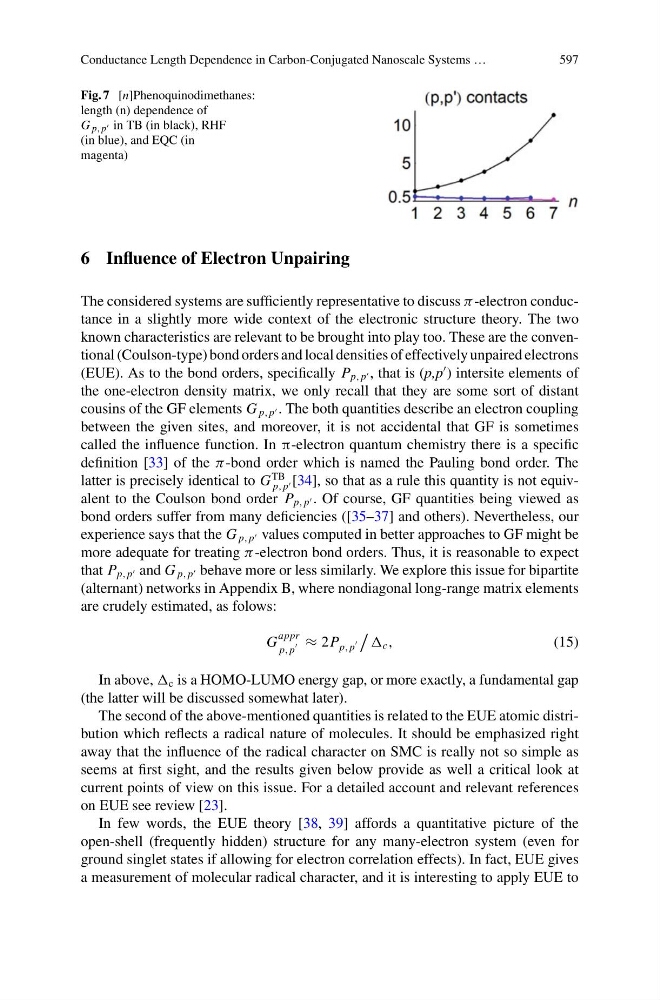
Fig. 7 [n]Phenoquinodimethanes:
length (n) dependence of
G p, p in TB (in black), RHF
(in blue), and EQC (in
magenta)
6 Influence of Electron Unpairing
The considered systems are sufficiently representative to discuss π -electron conductance in a slightly more wide context of the electronic structure theory. The two
known characteristics are relevant to be brought into play too. These are the conventional (Coulson-type) bond orders and local densities of effectively unpaired electrons
(EUE). As to the bond orders, specifically P p, p , that is (p,p
) intersite elements of
the one-electron density matrix, we only recall that they are some sort of distant
cousins of the GF elements G p, p . The both quantities describe an electron coupling
between the given sites, and moreover, it is not accidental that GF is sometimes
called the influence function. In π-electron quantum chemistry there is a specific
definition [33] of the π -bond order which is named the Pauling bond order. The
latter is precisely identical to G
TB
p, p [34], so that as a rule this quantity is not equivalent to the Coulson bond order P p, p . Of course, GF quantities being viewed as
bond orders suffer from many deficiencies ([35–37] and others). Nevertheless, our
experience says that the G p, p values computed in better approaches to GF might be
more adequate for treating π -electron bond orders. Thus, it is reasonable to expect
that P p, p and G p, p behave more or less similarly. We explore this issue for bipartite
(alternant) networks in Appendix B, where nondiagonal long-range matrix elements
are crudely estimated, as folows:
G
appr
p, p
≈ 2P p, p
c ,
(15)
In above, c is a HOMO-LUMO energy gap, or more exactly, a fundamental gap
(the latter will be discussed somewhat later).
The second of the above-mentioned quantities is related to the EUE atomic distribution which reflects a radical nature of molecules. It should be emphasized right
away that the influence of the radical character on SMC is really not so simple as
seems at first sight, and the results given below provide as well a critical look at
current points of view on this issue. For a detailed account and relevant references
on EUE see review [23].
In few words, the EUE theory [38, 39] affords a quantitative picture of the
open-shell (frequently hidden) structure for any many-electron system (even for
ground singlet states if allowing for electron correlation effects). In fact, EUE gives
a measurement of molecular radical character, and it is interesting to apply EUE to