

Conductance Length Dependence in Carbon-Conjugated Nanoscale Systems …
595
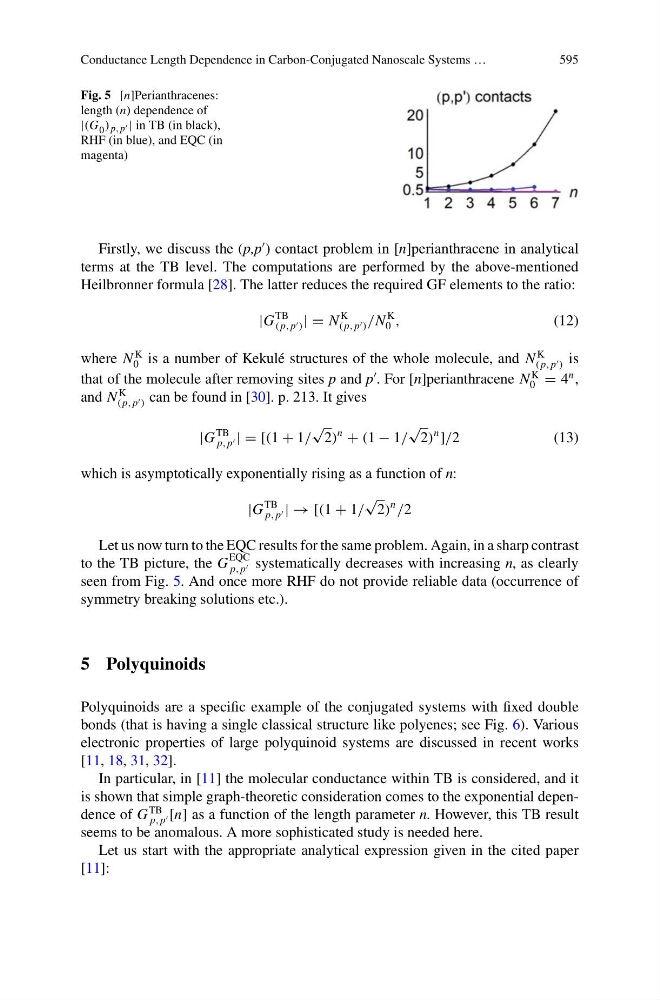
Fig. 5 [n]Perianthracenes:
length (n) dependence of
|(G 0 ) p, p | in TB (in black),
RHF (in blue), and EQC (in
magenta)
Firstly, we discuss the (p,p
) contact problem in [n]perianthracene in analytical
terms at the TB level. The computations are performed by the above-mentioned
Heilbronner formula [28]. The latter reduces the required GF elements to the ratio:
|G
TB
( p, p ) | = N
K
( p, p ) /N
K
0 ,
(12)
where N
K
0 is a number of Kekulé structures of the whole molecule, and N
K
( p, p ) is
that of the molecule after removing sites p and p
. For [n]perianthracene N
K
0 = 4
n ,
and N
K
( p, p ) can be found in [30]. p. 213. It gives
|G
TB
p, p | = [(1 + 1/
√
2)
n
+ (1 − 1/
√
2)
n
]/2
(13)
which is asymptotically exponentially rising as a function of n:
|G
TB
p, p | → [(1 + 1/
√
2)
n
/2
Let us now turn to the EQC results for the same problem. Again, in a sharp contrast
to the TB picture, the G
EQC
p, p systematically decreases with increasing n, as clearly
seen from Fig. 5. And once more RHF do not provide reliable data (occurrence of
symmetry breaking solutions etc.).
5 Polyquinoids
Polyquinoids are a specific example of the conjugated systems with fixed double
bonds (that is having a single classical structure like polyenes; see Fig. 6). Various
electronic properties of large polyquinoid systems are discussed in recent works
[11, 18, 31, 32].
In particular, in [11] the molecular conductance within TB is considered, and it
is shown that simple graph-theoretic consideration comes to the exponential dependence of G
TB
p, p [n] as a function of the length parameter n. However, this TB result
seems to be anomalous. A more sophisticated study is needed here.
Let us start with the appropriate analytical expression given in the cited paper
[11]: