

594
A. V. Luzanov
G
TB
p, p [2k + 1] = (k + 1)/2,
(7)
and for even n = 2k
G
TB
p, p [2k] = k(k + 1)/(2k + 1).
(8)
Respectively, for a farest-distance type contacts one finds
G
TB
f, f [n] = 1/(n + 1).
(9)
Of course, (7)–(9) reproduce the results of the last column in Table 3. No less
interesting is the asymptotic behavior of these expressions when n goes to infinity:
G
TB
p, p → n/4,
(10)
G
TB
f, f → 0.
(11)
Now look at the plots in Fig. 3. We see that the TB curve for para contacts naturally
follows (10) whereas the curves given by other methods are qualitatively perfectly
different. More precisely, EQC predicts the opposite effect of a quick saturation of
G p, p elements with increasing acene length. The RHF model admits only a slight
increase of G p, p but not so large as in TB. Along with this, the RHF solutions
become unstable for large n, so that these solutions lost physical meaning for too
long acenes. At any rate, the EQC upshot as to a small finite limit value of G p, p seems
to be quite reasonable. Notice that in qualitatively terms, the QCTB data (not given
here explicitly) are the same as the EQC ones. The case of (f,f
) pairs is described
realistically by all π - models used here for linear acenes (see the left panel in Fig. 3).
Next we consider the graphenic structures. Small and large graphene networks
are typical for applications of the SMC theory [29], particularly in its TB version
[3, 26]. The conductance length dependence for graphene-like molecules was examined recently in [12] from which we take representative examples of small systems
comprising of the anthracene structure subunits. Here we extend the consideration
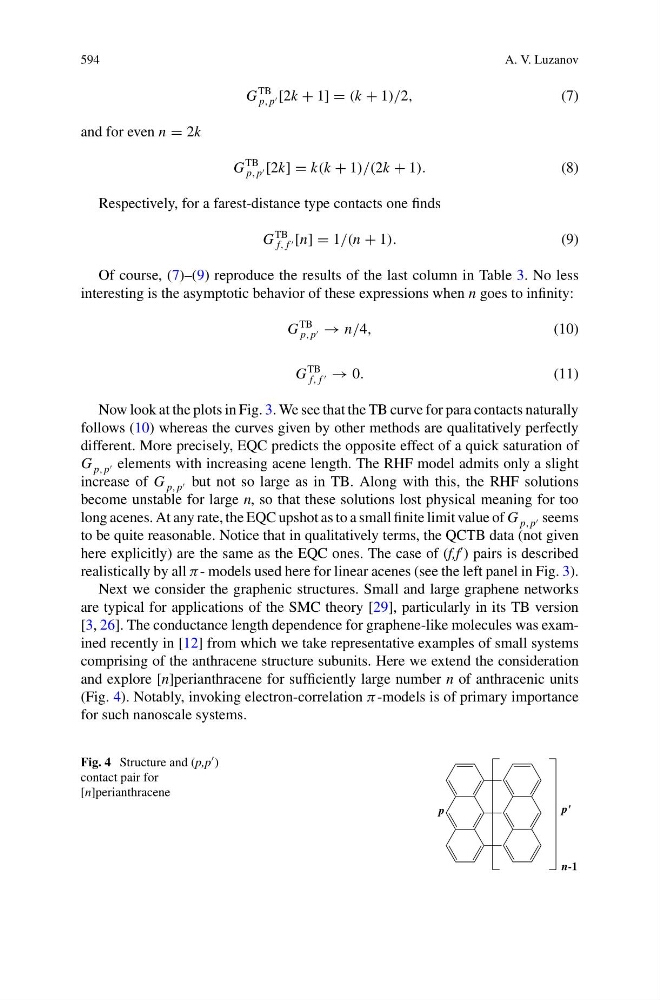
and explore [n]perianthracene for sufficiently large number n of anthracenic units
(Fig. 4). Notably, invoking electron-correlation π -models is of primary importance
for such nanoscale systems.
Fig. 4 Structure and (p,p )
contact pair for
[n]perianthracene
p
p'
n-1