

Conductance Length Dependence in Carbon-Conjugated Nanoscale Systems …
593
p'
p
p
p'
f
f'
p
p'
f
f'
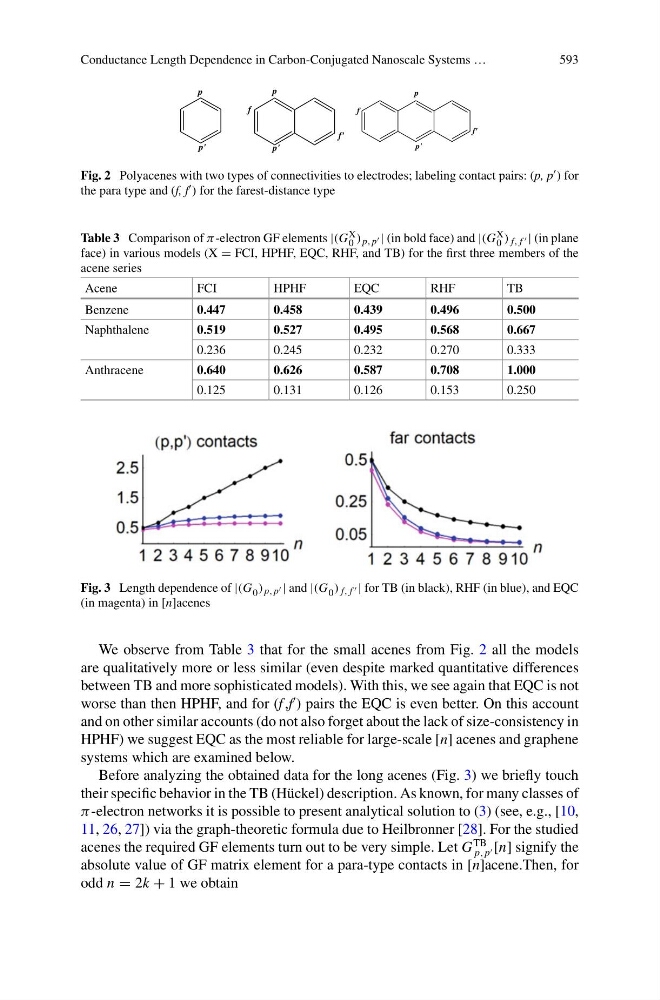
Fig. 2 Polyacenes with two types of connectivities to electrodes; labeling contact pairs: (p, p ) for
the para type and (f, f ) for the farest-distance type
Table 3 Comparison of π -electron GF elements |(G X
0 ) p, p | (in bold face) and |(G X
0 ) f, f | (in plane
face) in various models (X = FCI, HPHF, EQC, RHF, and TB) for the first three members of the
acene series
Acene
FCI
HPHF
EQC
RHF
TB
Benzene
0.447
0.458
0.439
0.496
0.500
Naphthalene
0.519
0.527
0.495
0.568
0.667
0.236
0.245
0.232
0.270
0.333
Anthracene
0.640
0.626
0.587
0.708
1.000
0.125
0.131
0.126
0.153
0.250
Fig. 3 Length dependence of |(G 0 ) p, p | and |(G 0 ) f, f | for TB (in black), RHF (in blue), and EQC
(in magenta) in [n]acenes
We observe from Table 3 that for the small acenes from Fig. 2 all the models
are qualitatively more or less similar (even despite marked quantitative differences
between TB and more sophisticated models). With this, we see again that EQC is not
worse than then HPHF, and for (f ,f
) pairs the EQC is even better. On this account
and on other similar accounts (do not also forget about the lack of size-consistency in
HPHF) we suggest EQC as the most reliable for large-scale [n] acenes and graphene
systems which are examined below.
Before analyzing the obtained data for the long acenes (Fig. 3) we briefly touch
their specific behavior in the TB (Hückel) description. As known, for many classes of
π -electron networks it is possible to present analytical solution to (3) (see, e.g., [10,
11, 26, 27]) via the graph-theoretic formula due to Heilbronner [28]. For the studied
acenes the required GF elements turn out to be very simple. Let G
TB
p, p [n] signify the
absolute value of GF matrix element for a para-type contacts in [n]acene.Then, for
odd n = 2k + 1 we obtain