

592
A. V. Luzanov
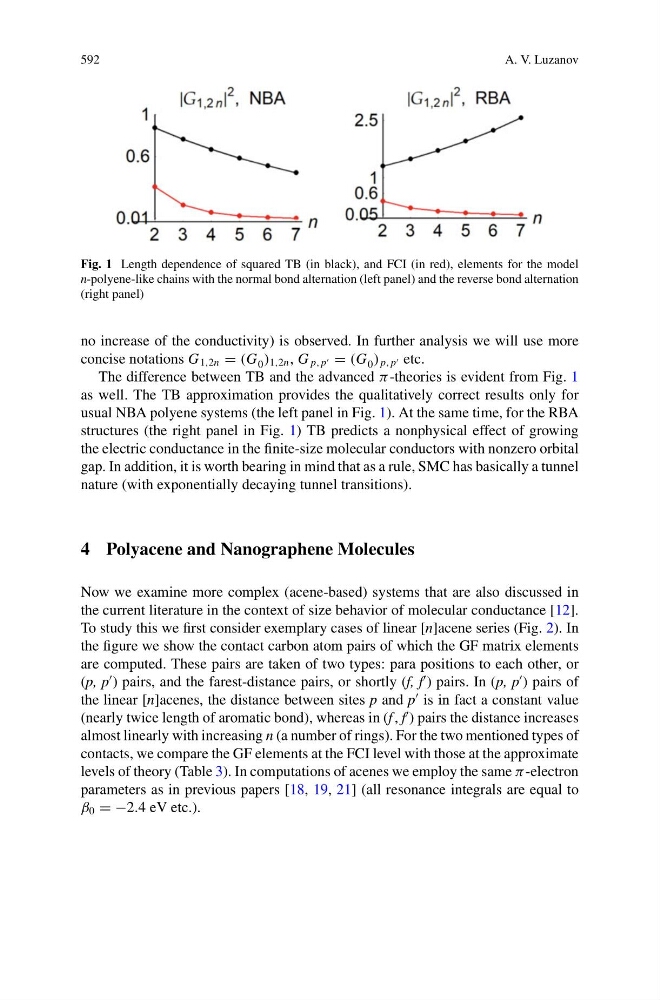
Fig. 1 Length dependence of squared TB (in black), and FCI (in red), elements for the model
n-polyene-like chains with the normal bond alternation (left panel) and the reverse bond alternation
(right panel)
no increase of the conductivity) is observed. In further analysis we will use more
concise notations G 1,2n = (G 0 ) 1,2n , G p, p = (G 0 ) p, p etc.
The difference between TB and the advanced π -theories is evident from Fig. 1
as well. The TB approximation provides the qualitatively correct results only for
usual NBA polyene systems (the left panel in Fig. 1). At the same time, for the RBA
structures (the right panel in Fig. 1) TB predicts a nonphysical effect of growing
the electric conductance in the finite-size molecular conductors with nonzero orbital
gap. In addition, it is worth bearing in mind that as a rule, SMC has basically a tunnel
nature (with exponentially decaying tunnel transitions).
4 Polyacene and Nanographene Molecules
Now we examine more complex (acene-based) systems that are also discussed in
the current literature in the context of size behavior of molecular conductance [12].
To study this we first consider exemplary cases of linear [n]acene series (Fig. 2). In
the figure we show the contact carbon atom pairs of which the GF matrix elements
are computed. These pairs are taken of two types: para positions to each other, or
(p, p
) pairs, and the farest-distance pairs, or shortly (f, f
) pairs. In (p, p
) pairs of
the linear [n]acenes, the distance between sites p and p
is in fact a constant value
(nearly twice length of aromatic bond), whereas in (f , f
) pairs the distance increases
almost linearly with increasing n (a number of rings). For the two mentioned types of
contacts, we compare the GF elements at the FCI level with those at the approximate
levels of theory (Table 3). In computations of acenes we employ the same π -electron
parameters as in previous papers [18, 19, 21] (all resonance integrals are equal to
β 0 = −2.4 eV etc.).