

Predicting Phase Stability of Materials Based on …
575
The difference between the critical temperature for a system containing Ho
(1150 K) and the temperature of spontaneous quenching (~1173 K) is less than
the calculation error (±100 K [17]); therefore, it is difficult to predict decomposition
of an unlimited solid solution in this system.
Similarly, limited solid solutions with x = 0.01, 0.03, 0.05, 0.10, and 0.20 in the
regions above the curves a, b, c, d, and e, respectively, are thermodynamically stable
(Fig. 1), in the regions below the curves they are unstable and can decay, while at T
< 1173 K they are metastable.
Although there are numerous publications, which study the laser properties of
scandium oxyorthosilicate, doped with, for example, 0.5 at.% of holmium [3], 1 at.%
of neodymium [9, 27], 4 at.% of thulium [7], 5 at.% of ytterbium [28], and others,
and in some papers on the properties of “mixed” oxyorthosilicates Y(Lu,Sc) 2 SiO 5
[2], (Sc 0.5 Y 0.5 ) 2 SiO 5 [8, 10], (Sc 0.2 Y 0.8 ) 2 SiO 5 [11], there is practically no data
on the limits of isomorphous substitutions in the corresponding systems. This, of
course, makes it difficult to assess the reliability of our calculations. However, they
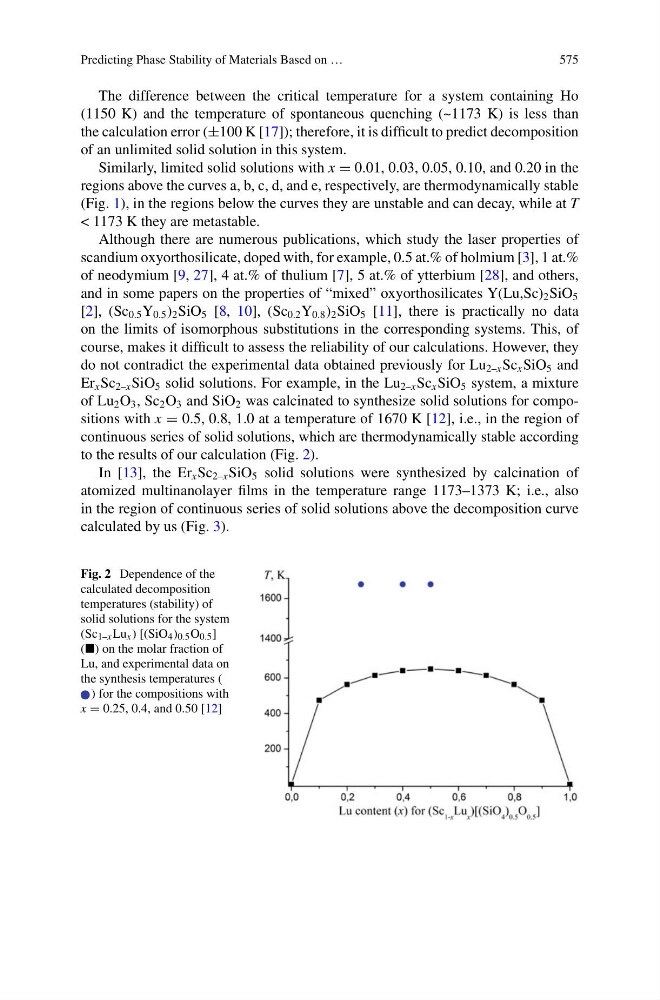
do not contradict the experimental data obtained previously for Lu 2–x Sc x SiO 5 and
Er x Sc 2–x SiO 5 solid solutions. For example, in the Lu 2–x Sc x SiO 5 system, a mixture
of Lu 2 O 3 , Sc 2 O 3 and SiO 2 was calcinated to synthesize solid solutions for compositions with x = 0.5, 0.8, 1.0 at a temperature of 1670 K [12], i.e., in the region of
continuous series of solid solutions, which are thermodynamically stable according
to the results of our calculation (Fig. 2).
In [13], the Er x Sc 2–x SiO 5 solid solutions were synthesized by calcination of
atomized multinanolayer films in the temperature range 1173–1373 K; i.e., also
in the region of continuous series of solid solutions above the decomposition curve
calculated by us (Fig. 3).
Fig. 2 Dependence of the
calculated decomposition
temperatures (stability) of
solid solutions for the system
(Sc 1–x Lu x ) [(SiO 4 ) 0.5 O 0.5 ]
() on the molar fraction of
Lu, and experimental data on
the synthesis temperatures (
) for the compositions with
x = 0.25, 0.4, and 0.50 [12]
575
The difference between the critical temperature for a system containing Ho
(1150 K) and the temperature of spontaneous quenching (~1173 K) is less than
the calculation error (±100 K [17]); therefore, it is difficult to predict decomposition
of an unlimited solid solution in this system.
Similarly, limited solid solutions with x = 0.01, 0.03, 0.05, 0.10, and 0.20 in the
regions above the curves a, b, c, d, and e, respectively, are thermodynamically stable
(Fig. 1), in the regions below the curves they are unstable and can decay, while at T
< 1173 K they are metastable.
Although there are numerous publications, which study the laser properties of
scandium oxyorthosilicate, doped with, for example, 0.5 at.% of holmium [3], 1 at.%
of neodymium [9, 27], 4 at.% of thulium [7], 5 at.% of ytterbium [28], and others,
and in some papers on the properties of “mixed” oxyorthosilicates Y(Lu,Sc) 2 SiO 5
[2], (Sc 0.5 Y 0.5 ) 2 SiO 5 [8, 10], (Sc 0.2 Y 0.8 ) 2 SiO 5 [11], there is practically no data
on the limits of isomorphous substitutions in the corresponding systems. This, of
course, makes it difficult to assess the reliability of our calculations. However, they
do not contradict the experimental data obtained previously for Lu 2–x Sc x SiO 5 and
Er x Sc 2–x SiO 5 solid solutions. For example, in the Lu 2–x Sc x SiO 5 system, a mixture
of Lu 2 O 3 , Sc 2 O 3 and SiO 2 was calcinated to synthesize solid solutions for compositions with x = 0.5, 0.8, 1.0 at a temperature of 1670 K [12], i.e., in the region of
continuous series of solid solutions, which are thermodynamically stable according
to the results of our calculation (Fig. 2).
In [13], the Er x Sc 2–x SiO 5 solid solutions were synthesized by calcination of
atomized multinanolayer films in the temperature range 1173–1373 K; i.e., also
in the region of continuous series of solid solutions above the decomposition curve
calculated by us (Fig. 3).
Fig. 2 Dependence of the
calculated decomposition
temperatures (stability) of
solid solutions for the system
(Sc 1–x Lu x ) [(SiO 4 ) 0.5 O 0.5 ]
() on the molar fraction of
Lu, and experimental data on
the synthesis temperatures (
) for the compositions with
x = 0.25, 0.4, and 0.50 [12]