

574
E. I. Get’man and S. V. Radio
Table 3 Methods and temperatures for the synthesis of REE oxyorthosilicates
Method of synthesis
Composition
T, K
Calcination of multinanolayer films [13]
Sc 2–x Er x SiO 5
1173–1373
Solution combustion synthesis (SCS) [25]
Lu 2 SiO 5 :Ce
1273
Gd 2 SiO 5 :Ce
1273
Y 2 SiO 5 :Ce
1273
Sol–gel method followed by calcination [26]
Y 2 SiO 5
1323
Tb 2 SiO 5
1323
Dy 2 SiO 5
1323
Ho 2 SiO 5
1273
Er 2 SiO 5
1273
Tm 2 SiO 5
1273
Yb 2 SiO 5
1223
Lu 2 SiO5
1173
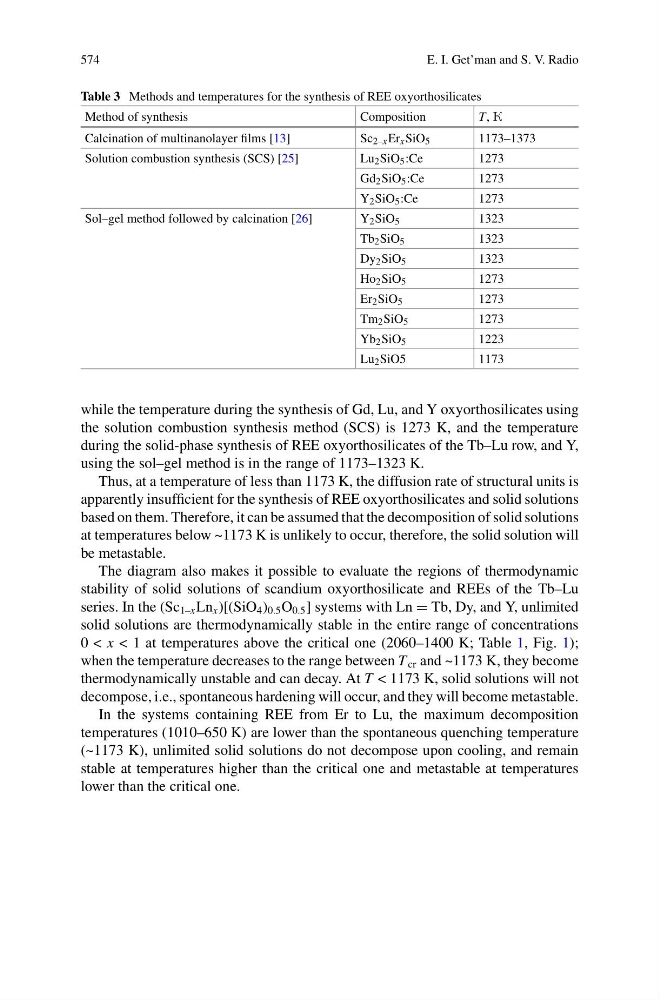
while the temperature during the synthesis of Gd, Lu, and Y oxyorthosilicates using
the solution combustion synthesis method (SCS) is 1273 K, and the temperature
during the solid-phase synthesis of REE oxyorthosilicates of the Tb–Lu row, and Y,
using the sol–gel method is in the range of 1173–1323 K.
Thus, at a temperature of less than 1173 K, the diffusion rate of structural units is
apparently insufficient for the synthesis of REE oxyorthosilicates and solid solutions
based on them. Therefore, it can be assumed that the decomposition of solid solutions
at temperatures below ~1173 K is unlikely to occur, therefore, the solid solution will
be metastable.
The diagram also makes it possible to evaluate the regions of thermodynamic
stability of solid solutions of scandium oxyorthosilicate and REEs of the Tb–Lu
series. In the (Sc 1–x Ln x )[(SiO 4 ) 0.5 O 0.5 ] systems with Ln = Tb, Dy, and Y, unlimited
solid solutions are thermodynamically stable in the entire range of concentrations
0 < x < 1 at temperatures above the critical one (2060–1400 K; Table 1, Fig. 1);
when the temperature decreases to the range between T cr and ~1173 K, they become
thermodynamically unstable and can decay. At T < 1173 K, solid solutions will not
decompose, i.e., spontaneous hardening will occur, and they will become metastable.
In the systems containing REE from Er to Lu, the maximum decomposition
temperatures (1010–650 K) are lower than the spontaneous quenching temperature
(~1173 K), unlimited solid solutions do not decompose upon cooling, and remain
stable at temperatures higher than the critical one and metastable at temperatures
lower than the critical one.
E. I. Get’man and S. V. Radio
Table 3 Methods and temperatures for the synthesis of REE oxyorthosilicates
Method of synthesis
Composition
T, K
Calcination of multinanolayer films [13]
Sc 2–x Er x SiO 5
1173–1373
Solution combustion synthesis (SCS) [25]
Lu 2 SiO 5 :Ce
1273
Gd 2 SiO 5 :Ce
1273
Y 2 SiO 5 :Ce
1273
Sol–gel method followed by calcination [26]
Y 2 SiO 5
1323
Tb 2 SiO 5
1323
Dy 2 SiO 5
1323
Ho 2 SiO 5
1273
Er 2 SiO 5
1273
Tm 2 SiO 5
1273
Yb 2 SiO 5
1223
Lu 2 SiO5
1173
while the temperature during the synthesis of Gd, Lu, and Y oxyorthosilicates using
the solution combustion synthesis method (SCS) is 1273 K, and the temperature
during the solid-phase synthesis of REE oxyorthosilicates of the Tb–Lu row, and Y,
using the sol–gel method is in the range of 1173–1323 K.
Thus, at a temperature of less than 1173 K, the diffusion rate of structural units is
apparently insufficient for the synthesis of REE oxyorthosilicates and solid solutions
based on them. Therefore, it can be assumed that the decomposition of solid solutions
at temperatures below ~1173 K is unlikely to occur, therefore, the solid solution will
be metastable.
The diagram also makes it possible to evaluate the regions of thermodynamic
stability of solid solutions of scandium oxyorthosilicate and REEs of the Tb–Lu
series. In the (Sc 1–x Ln x )[(SiO 4 ) 0.5 O 0.5 ] systems with Ln = Tb, Dy, and Y, unlimited
solid solutions are thermodynamically stable in the entire range of concentrations
0 < x < 1 at temperatures above the critical one (2060–1400 K; Table 1, Fig. 1);
when the temperature decreases to the range between T cr and ~1173 K, they become
thermodynamically unstable and can decay. At T < 1173 K, solid solutions will not
decompose, i.e., spontaneous hardening will occur, and they will become metastable.
In the systems containing REE from Er to Lu, the maximum decomposition
temperatures (1010–650 K) are lower than the spontaneous quenching temperature
(~1173 K), unlimited solid solutions do not decompose upon cooling, and remain
stable at temperatures higher than the critical one and metastable at temperatures
lower than the critical one.