

576
E. I. Get’man and S. V. Radio
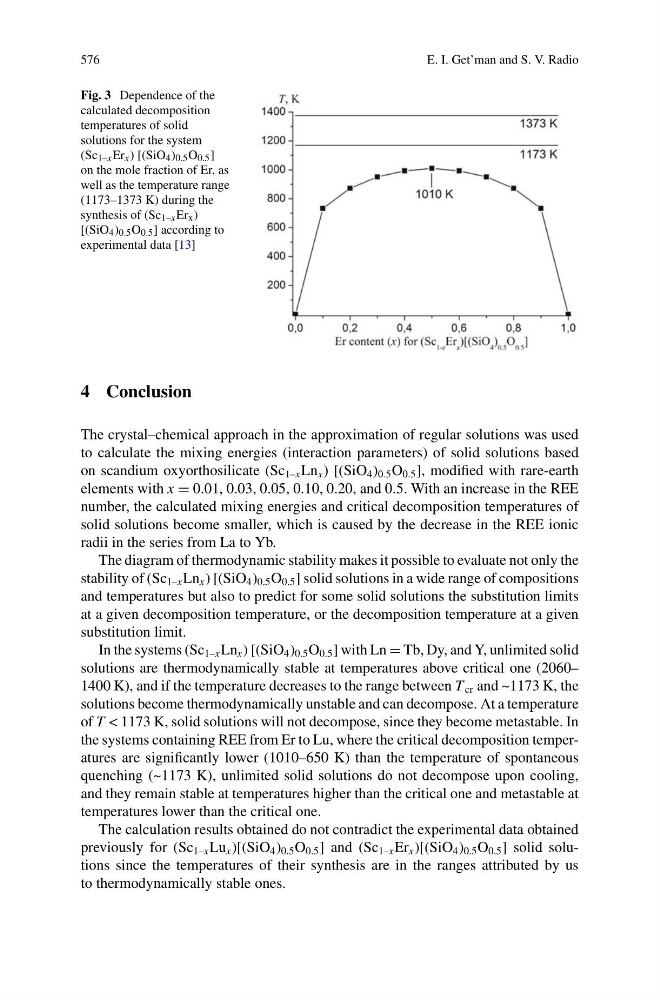
Fig. 3 Dependence of the
calculated decomposition
temperatures of solid
solutions for the system
(Sc 1–x Er x ) [(SiO 4 ) 0.5 O 0.5 ]
on the mole fraction of Er, as
well as the temperature range
(1173–1373 K) during the
synthesis of (Sc 1–x Er x )
[(SiO 4 ) 0.5 O 0.5 ] according to
experimental data [13]
4 Conclusion
The crystal–chemical approach in the approximation of regular solutions was used
to calculate the mixing energies (interaction parameters) of solid solutions based
on scandium oxyorthosilicate (Sc 1–x Ln x ) [(SiO 4 ) 0.5 O 0.5 ], modified with rare-earth
elements with x = 0.01, 0.03, 0.05, 0.10, 0.20, and 0.5. With an increase in the REE
number, the calculated mixing energies and critical decomposition temperatures of
solid solutions become smaller, which is caused by the decrease in the REE ionic
radii in the series from La to Yb.
The diagram of thermodynamic stability makes it possible to evaluate not only the
stability of (Sc 1–x Ln x ) [(SiO 4 ) 0.5 O 0.5 ] solid solutions in a wide range of compositions
and temperatures but also to predict for some solid solutions the substitution limits
at a given decomposition temperature, or the decomposition temperature at a given
substitution limit.
In the systems (Sc 1–x Ln x ) [(SiO 4 ) 0.5 O 0.5 ] with Ln = Tb, Dy, and Y, unlimited solid
solutions are thermodynamically stable at temperatures above critical one (2060–
1400 K), and if the temperature decreases to the range between T cr and ~1173 K, the
solutions become thermodynamically unstable and can decompose. At a temperature
of T < 1173 K, solid solutions will not decompose, since they become metastable. In
the systems containing REE from Er to Lu, where the critical decomposition temperatures are significantly lower (1010–650 K) than the temperature of spontaneous
quenching (~1173 K), unlimited solid solutions do not decompose upon cooling,
and they remain stable at temperatures higher than the critical one and metastable at
temperatures lower than the critical one.
The calculation results obtained do not contradict the experimental data obtained
previously for (Sc 1–x Lu x )[(SiO 4 ) 0.5 O 0.5 ] and (Sc 1–x Er x )[(SiO 4 ) 0.5 O 0.5 ] solid solutions since the temperatures of their synthesis are in the ranges attributed by us
to thermodynamically stable ones.
E. I. Get’man and S. V. Radio
Fig. 3 Dependence of the
calculated decomposition
temperatures of solid
solutions for the system
(Sc 1–x Er x ) [(SiO 4 ) 0.5 O 0.5 ]
on the mole fraction of Er, as
well as the temperature range
(1173–1373 K) during the
synthesis of (Sc 1–x Er x )
[(SiO 4 ) 0.5 O 0.5 ] according to
experimental data [13]
4 Conclusion
The crystal–chemical approach in the approximation of regular solutions was used
to calculate the mixing energies (interaction parameters) of solid solutions based
on scandium oxyorthosilicate (Sc 1–x Ln x ) [(SiO 4 ) 0.5 O 0.5 ], modified with rare-earth
elements with x = 0.01, 0.03, 0.05, 0.10, 0.20, and 0.5. With an increase in the REE
number, the calculated mixing energies and critical decomposition temperatures of
solid solutions become smaller, which is caused by the decrease in the REE ionic
radii in the series from La to Yb.
The diagram of thermodynamic stability makes it possible to evaluate not only the
stability of (Sc 1–x Ln x ) [(SiO 4 ) 0.5 O 0.5 ] solid solutions in a wide range of compositions
and temperatures but also to predict for some solid solutions the substitution limits
at a given decomposition temperature, or the decomposition temperature at a given
substitution limit.
In the systems (Sc 1–x Ln x ) [(SiO 4 ) 0.5 O 0.5 ] with Ln = Tb, Dy, and Y, unlimited solid
solutions are thermodynamically stable at temperatures above critical one (2060–
1400 K), and if the temperature decreases to the range between T cr and ~1173 K, the
solutions become thermodynamically unstable and can decompose. At a temperature
of T < 1173 K, solid solutions will not decompose, since they become metastable. In
the systems containing REE from Er to Lu, where the critical decomposition temperatures are significantly lower (1010–650 K) than the temperature of spontaneous
quenching (~1173 K), unlimited solid solutions do not decompose upon cooling,
and they remain stable at temperatures higher than the critical one and metastable at
temperatures lower than the critical one.
The calculation results obtained do not contradict the experimental data obtained
previously for (Sc 1–x Lu x )[(SiO 4 ) 0.5 O 0.5 ] and (Sc 1–x Er x )[(SiO 4 ) 0.5 O 0.5 ] solid solutions since the temperatures of their synthesis are in the ranges attributed by us
to thermodynamically stable ones.