

562
O. I. Kushnerov et al.
For the as-cast sample of Fe 25 B 17.5 Co 21.35 Nb 3.65 Ni 25 Si 7.5 HEA, the structure is
consists of a simple face-centered cubic phase and Fe 2 B phase. The lattice parameters
of the face-centered cubic phase suggest that it is formed based on γ-iron (in [3] the
lattice parameter a of γ-iron was extrapolated at room temperature as 0.3572 nm).
For the splat-quenched Fe 25 B 17.5 Co 21.35 Nb 3.65 Ni 25 Si 7.5 alloy films, the XRD
pattern does not contain any clear crystalline peaks, only a broad maximum. This is
a sign of a completely glassy structure. A coherently scattering domain size (crystallite size) of HE-MG estimated by the Scherrer formula was ~ 3 nm. After annealing
to ~1010 K (above the crystallization temperature) and subsequent slow cooling,
the films crystallize with the formation of several crystalline phases (Table 2). The
much more complex phase composition that is observed in annealed films compared
to as-cast samples is obviously explained by their low cooling rate. As a result, a
substantially more equilibrium multiphase state is formed in the annealed films.
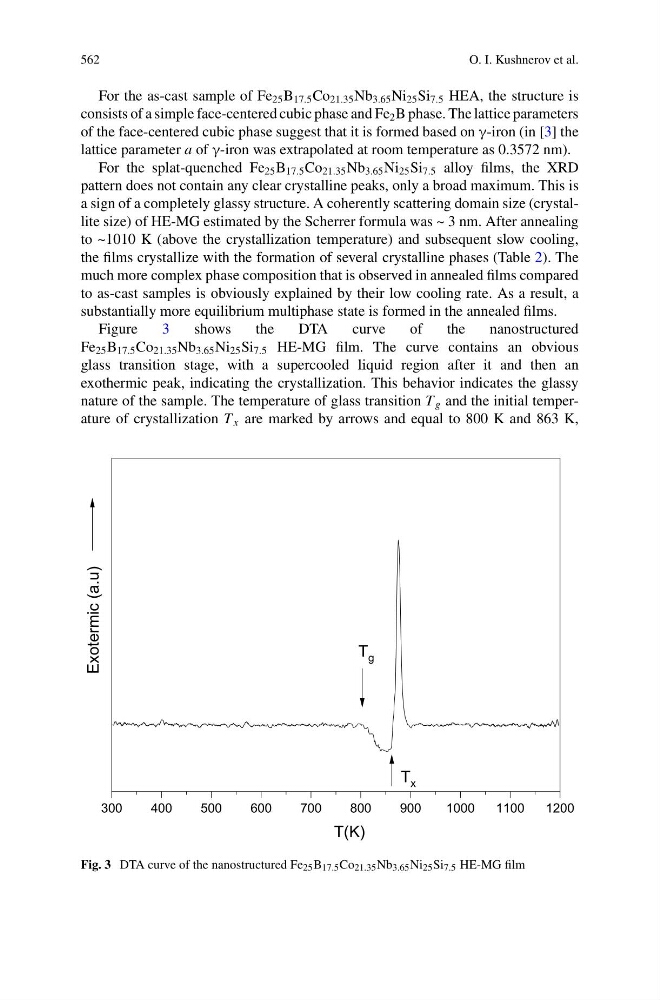
Figure
3
shows
the
DTA
curve
of
the
nanostructured
Fe 25 B 17.5 Co 21.35 Nb 3.65 Ni 25 Si 7.5 HE-MG film. The curve contains an obvious
glass transition stage, with a supercooled liquid region after it and then an
exothermic peak, indicating the crystallization. This behavior indicates the glassy
nature of the sample. The temperature of glass transition T g and the initial temperature of crystallization T x are marked by arrows and equal to 800 K and 863 K,
300
400
500
600
700
800
900
1000
1100
1200
Exotermic (a.u)
T(K)
T g
T x
Fig. 3 DTA curve of the nanostructured Fe 25 B 17.5 Co 21.35 Nb 3.65 Ni 25 Si 7.5 HE-MG film
O. I. Kushnerov et al.
For the as-cast sample of Fe 25 B 17.5 Co 21.35 Nb 3.65 Ni 25 Si 7.5 HEA, the structure is
consists of a simple face-centered cubic phase and Fe 2 B phase. The lattice parameters
of the face-centered cubic phase suggest that it is formed based on γ-iron (in [3] the
lattice parameter a of γ-iron was extrapolated at room temperature as 0.3572 nm).
For the splat-quenched Fe 25 B 17.5 Co 21.35 Nb 3.65 Ni 25 Si 7.5 alloy films, the XRD
pattern does not contain any clear crystalline peaks, only a broad maximum. This is
a sign of a completely glassy structure. A coherently scattering domain size (crystallite size) of HE-MG estimated by the Scherrer formula was ~ 3 nm. After annealing
to ~1010 K (above the crystallization temperature) and subsequent slow cooling,
the films crystallize with the formation of several crystalline phases (Table 2). The
much more complex phase composition that is observed in annealed films compared
to as-cast samples is obviously explained by their low cooling rate. As a result, a
substantially more equilibrium multiphase state is formed in the annealed films.
Figure
3
shows
the
DTA
curve
of
the
nanostructured
Fe 25 B 17.5 Co 21.35 Nb 3.65 Ni 25 Si 7.5 HE-MG film. The curve contains an obvious
glass transition stage, with a supercooled liquid region after it and then an
exothermic peak, indicating the crystallization. This behavior indicates the glassy
nature of the sample. The temperature of glass transition T g and the initial temperature of crystallization T x are marked by arrows and equal to 800 K and 863 K,
300
400
500
600
700
800
900
1000
1100
1200
Exotermic (a.u)
T(K)
T g
T x
Fig. 3 DTA curve of the nanostructured Fe 25 B 17.5 Co 21.35 Nb 3.65 Ni 25 Si 7.5 HE-MG film