

Structure and Properties of Nanostructured Metallic Glass …
563
200
300
400
500
600
700
800
900
1000
1100
0.80
0.85
0.90
0.95
1.00
1.05
R/R
0
T(K)
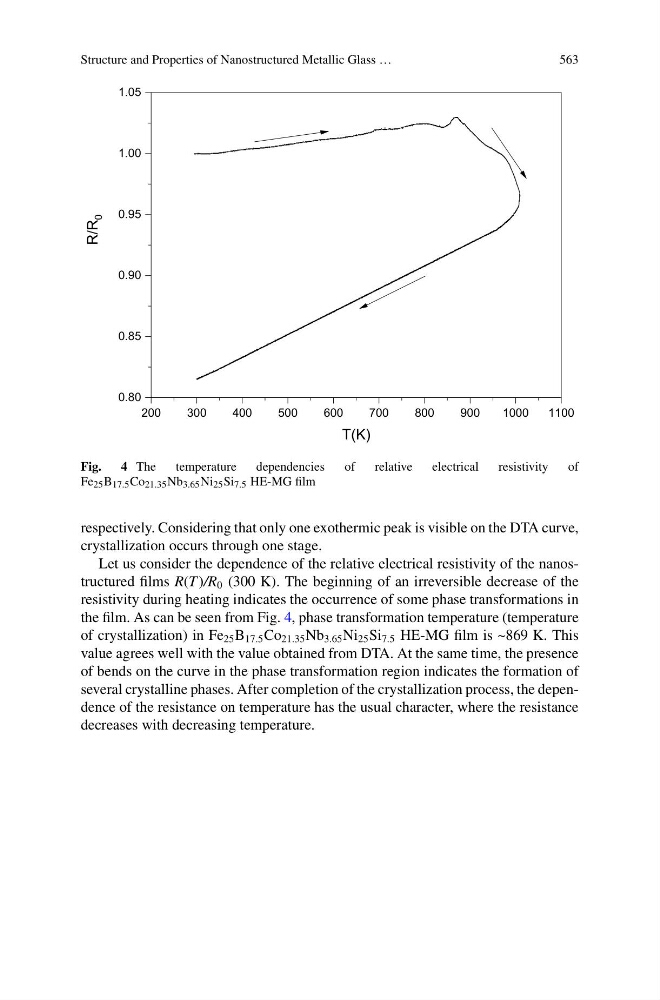
Fig.
4 The
temperature
dependencies
of
relative
electrical
resistivity
of
Fe 25 B 17.5 Co 21.35 Nb 3.65 Ni 25 Si 7.5 HE-MG film
respectively. Considering that only one exothermic peak is visible on the DTA curve,
crystallization occurs through one stage.
Let us consider the dependence of the relative electrical resistivity of the nanostructured films R(T )/R 0 (300 K). The beginning of an irreversible decrease of the
resistivity during heating indicates the occurrence of some phase transformations in
the film. As can be seen from Fig. 4, phase transformation temperature (temperature
of crystallization) in Fe 25 B 17.5 Co 21.35 Nb 3.65 Ni 25 Si 7.5 HE-MG film is ~869 K. This
value agrees well with the value obtained from DTA. At the same time, the presence
of bends on the curve in the phase transformation region indicates the formation of
several crystalline phases. After completion of the crystallization process, the dependence of the resistance on temperature has the usual character, where the resistance
decreases with decreasing temperature.
563
200
300
400
500
600
700
800
900
1000
1100
0.80
0.85
0.90
0.95
1.00
1.05
R/R
0
T(K)
Fig.
4 The
temperature
dependencies
of
relative
electrical
resistivity
of
Fe 25 B 17.5 Co 21.35 Nb 3.65 Ni 25 Si 7.5 HE-MG film
respectively. Considering that only one exothermic peak is visible on the DTA curve,
crystallization occurs through one stage.
Let us consider the dependence of the relative electrical resistivity of the nanostructured films R(T )/R 0 (300 K). The beginning of an irreversible decrease of the
resistivity during heating indicates the occurrence of some phase transformations in
the film. As can be seen from Fig. 4, phase transformation temperature (temperature
of crystallization) in Fe 25 B 17.5 Co 21.35 Nb 3.65 Ni 25 Si 7.5 HE-MG film is ~869 K. This
value agrees well with the value obtained from DTA. At the same time, the presence
of bends on the curve in the phase transformation region indicates the formation of
several crystalline phases. After completion of the crystallization process, the dependence of the resistance on temperature has the usual character, where the resistance
decreases with decreasing temperature.