

Structure and Properties of Nanostructured Metallic Glass …
561
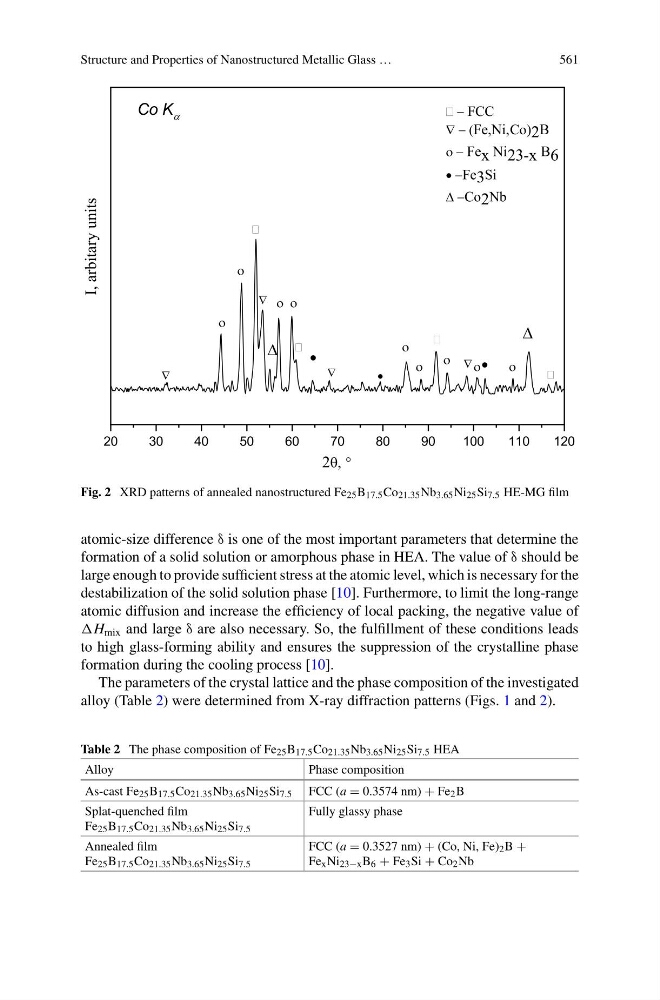
Fig. 2 XRD patterns of annealed nanostructured Fe 25 B 17.5 Co 21.35 Nb 3.65 Ni 25 Si 7.5 HE-MG film
atomic-size difference δ is one of the most important parameters that determine the
formation of a solid solution or amorphous phase in HEA. The value of δ should be
large enough to provide sufficient stress at the atomic level, which is necessary for the
destabilization of the solid solution phase [10]. Furthermore, to limit the long-range
atomic diffusion and increase the efficiency of local packing, the negative value of
mix and large δ are also necessary. So, the fulfillment of these conditions leads
to high glass-forming ability and ensures the suppression of the crystalline phase
formation during the cooling process [10].
The parameters of the crystal lattice and the phase composition of the investigated
alloy (Table 2) were determined from X-ray diffraction patterns (Figs. 1 and 2).
Table 2 The phase composition of Fe 25 B 17.5 Co 21.35 Nb 3.65 Ni 25 Si 7.5 HEA
Alloy
Phase composition
As-cast Fe 25 B 17.5 Co 21.35 Nb 3.65 Ni 25 Si 7.5 FCC (a = 0.3574 nm) + Fe 2 B
Splat-quenched film
Fe 25 B 17.5 Co 21.35 Nb 3.65 Ni 25 Si 7.5
Fully glassy phase
Annealed film
Fe 25 B 17.5 Co 21.35 Nb 3.65 Ni 25 Si 7.5
FCC (a = 0.3527 nm) + (Co, Ni, Fe) 2 B +
Fe x Ni 23−x B 6 + Fe 3 Si + Co 2 Nb
561
Fig. 2 XRD patterns of annealed nanostructured Fe 25 B 17.5 Co 21.35 Nb 3.65 Ni 25 Si 7.5 HE-MG film
atomic-size difference δ is one of the most important parameters that determine the
formation of a solid solution or amorphous phase in HEA. The value of δ should be
large enough to provide sufficient stress at the atomic level, which is necessary for the
destabilization of the solid solution phase [10]. Furthermore, to limit the long-range
atomic diffusion and increase the efficiency of local packing, the negative value of
mix and large δ are also necessary. So, the fulfillment of these conditions leads
to high glass-forming ability and ensures the suppression of the crystalline phase
formation during the cooling process [10].
The parameters of the crystal lattice and the phase composition of the investigated
alloy (Table 2) were determined from X-ray diffraction patterns (Figs. 1 and 2).
Table 2 The phase composition of Fe 25 B 17.5 Co 21.35 Nb 3.65 Ni 25 Si 7.5 HEA
Alloy
Phase composition
As-cast Fe 25 B 17.5 Co 21.35 Nb 3.65 Ni 25 Si 7.5 FCC (a = 0.3574 nm) + Fe 2 B
Splat-quenched film
Fe 25 B 17.5 Co 21.35 Nb 3.65 Ni 25 Si 7.5
Fully glassy phase
Annealed film
Fe 25 B 17.5 Co 21.35 Nb 3.65 Ni 25 Si 7.5
FCC (a = 0.3527 nm) + (Co, Ni, Fe) 2 B +
Fe x Ni 23−x B 6 + Fe 3 Si + Co 2 Nb