

524
A. Nosal-Wierci´ nska and W. Kaliszczak
processes. The attention is paid to the large role of complexes forming on the electrode surface and the essence of the location of depolarization reduction potential in
the area of labile adsorption equilibrium of organic matter [9].
The further significant impact of changes in the water activity and applied polarographically active accelerating organic substances on the mechanism and kinetics of
electroreduction of Bi(III) ions [10] extended the interpretation of the mechanism of
the “cap-pair” effect.
The studies of mixed adsorption layers in the aspect of their effect on the kinetics
of reduction of Zn(II) ions confirmed the increased dynamics of this process in
the presence of an inhibitor (n-butanol) and accelerating substances (thiourea and
selected toluidine isomers) [11, 12]. The dynamics of this two-stage electrode process
is reflected in a much greater increase in the value of kinetic parameters with an
increase in the concentration of the accelerating organic substance in the presence of
an inhibitor in the base electrolyte solution compared to a similar increase without
an inhibitor. This was explained by the weaker hydration of the electrode surface and
the interactions of co-adsorbate molecules.
The use of various surfactants for electrochemical studies allowed describing
the mechanism of the Zn(II) ion electroreduction process aplaying various models.
The catalytic effect of 1-decanesulfonic acid sodium salt on the electroreduction of
Zn(II) ions is closely related to the formed active complex and the orientation of the
adsorbed surfactant molecule on the mercury surface [13–15]. Among the theoretical
Fawcett models, the possibility of using the EE model to describe subsequent stages
of the electrode reaction was excluded [16].
Based on of the above, the study of the kinetics and mechanism of the electrode
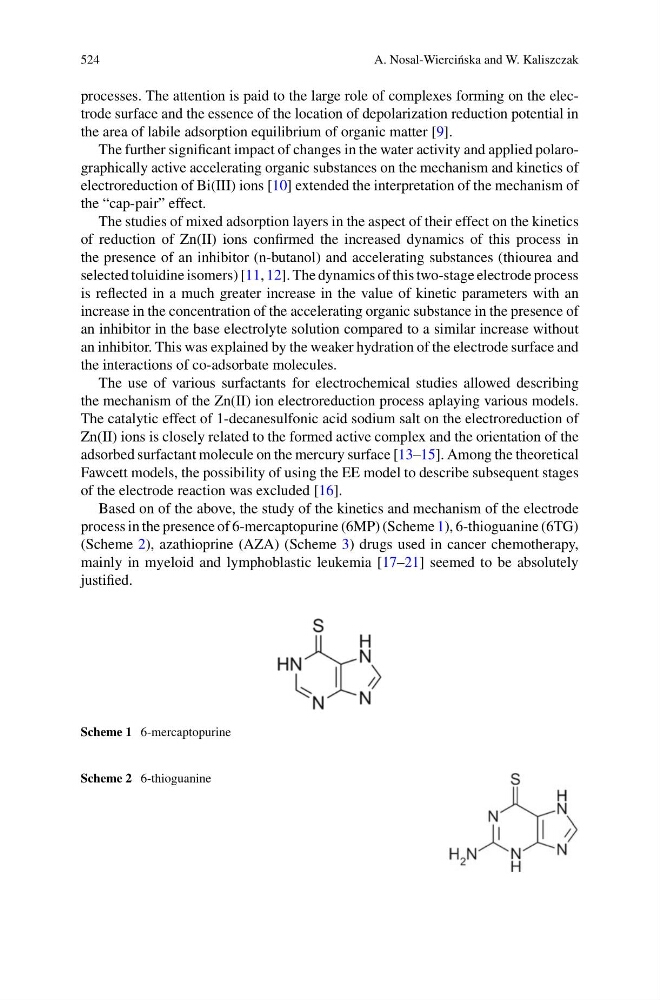
process in the presence of 6-mercaptopurine (6MP) (Scheme 1), 6-thioguanine (6TG)
(Scheme 2), azathioprine (AZA) (Scheme 3) drugs used in cancer chemotherapy,
mainly in myeloid and lymphoblastic leukemia [17–21] seemed to be absolutely
justified.
Scheme 1 6-mercaptopurine
Scheme 2 6-thioguanine
A. Nosal-Wierci´ nska and W. Kaliszczak
processes. The attention is paid to the large role of complexes forming on the electrode surface and the essence of the location of depolarization reduction potential in
the area of labile adsorption equilibrium of organic matter [9].
The further significant impact of changes in the water activity and applied polarographically active accelerating organic substances on the mechanism and kinetics of
electroreduction of Bi(III) ions [10] extended the interpretation of the mechanism of
the “cap-pair” effect.
The studies of mixed adsorption layers in the aspect of their effect on the kinetics
of reduction of Zn(II) ions confirmed the increased dynamics of this process in
the presence of an inhibitor (n-butanol) and accelerating substances (thiourea and
selected toluidine isomers) [11, 12]. The dynamics of this two-stage electrode process
is reflected in a much greater increase in the value of kinetic parameters with an
increase in the concentration of the accelerating organic substance in the presence of
an inhibitor in the base electrolyte solution compared to a similar increase without
an inhibitor. This was explained by the weaker hydration of the electrode surface and
the interactions of co-adsorbate molecules.
The use of various surfactants for electrochemical studies allowed describing
the mechanism of the Zn(II) ion electroreduction process aplaying various models.
The catalytic effect of 1-decanesulfonic acid sodium salt on the electroreduction of
Zn(II) ions is closely related to the formed active complex and the orientation of the
adsorbed surfactant molecule on the mercury surface [13–15]. Among the theoretical
Fawcett models, the possibility of using the EE model to describe subsequent stages
of the electrode reaction was excluded [16].
Based on of the above, the study of the kinetics and mechanism of the electrode
process in the presence of 6-mercaptopurine (6MP) (Scheme 1), 6-thioguanine (6TG)
(Scheme 2), azathioprine (AZA) (Scheme 3) drugs used in cancer chemotherapy,
mainly in myeloid and lymphoblastic leukemia [17–21] seemed to be absolutely
justified.
Scheme 1 6-mercaptopurine
Scheme 2 6-thioguanine