

Role of Active Complexes of Selected Thiopurine Derivatives …
525
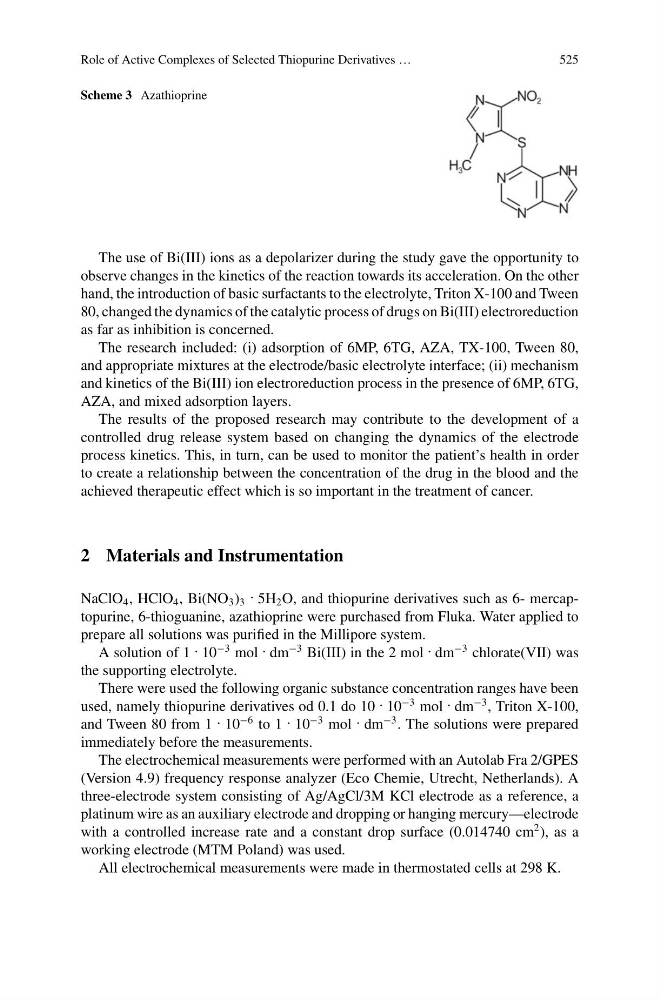
Scheme 3 Azathioprine
The use of Bi(III) ions as a depolarizer during the study gave the opportunity to
observe changes in the kinetics of the reaction towards its acceleration. On the other
hand, the introduction of basic surfactants to the electrolyte, Triton X-100 and Tween
80, changed the dynamics of the catalytic process of drugs on Bi(III) electroreduction
as far as inhibition is concerned.
The research included: (i) adsorption of 6MP, 6TG, AZA, TX-100, Tween 80,
and appropriate mixtures at the electrode/basic electrolyte interface; (ii) mechanism
and kinetics of the Bi(III) ion electroreduction process in the presence of 6MP, 6TG,
AZA, and mixed adsorption layers.
The results of the proposed research may contribute to the development of a
controlled drug release system based on changing the dynamics of the electrode
process kinetics. This, in turn, can be used to monitor the patient’s health in order
to create a relationship between the concentration of the drug in the blood and the
achieved therapeutic effect which is so important in the treatment of cancer.
2 Materials and Instrumentation
NaClO 4 , HClO 4 , Bi(NO 3 ) 3 : 5H 2 O, and thiopurine derivatives such as 6- mercaptopurine, 6-thioguanine, azathioprine were purchased from Fluka. Water applied to
prepare all solutions was purified in the Millipore system.
A solution of 1 : 10
−3 mol : dm
−3 Bi(III) in the 2 mol : dm
−3 chlorate(VII) was
the supporting electrolyte.
There were used the following organic substance concentration ranges have been
used, namely thiopurine derivatives od 0.1 do 10 : 10
−3 mol : dm
−3 , Triton X-100,
and Tween 80 from 1 : 10
−6 to 1 : 10
−3 mol : dm
−3 . The solutions were prepared
immediately before the measurements.
The electrochemical measurements were performed with an Autolab Fra 2/GPES
(Version 4.9) frequency response analyzer (Eco Chemie, Utrecht, Netherlands). A
three-electrode system consisting of Ag/AgCl/3M KCl electrode as a reference, a
platinum wire as an auxiliary electrode and dropping or hanging mercury—electrode
with a controlled increase rate and a constant drop surface (0.014740 cm
2 ), as a
working electrode (MTM Poland) was used.
All electrochemical measurements were made in thermostated cells at 298 K.
525
Scheme 3 Azathioprine
The use of Bi(III) ions as a depolarizer during the study gave the opportunity to
observe changes in the kinetics of the reaction towards its acceleration. On the other
hand, the introduction of basic surfactants to the electrolyte, Triton X-100 and Tween
80, changed the dynamics of the catalytic process of drugs on Bi(III) electroreduction
as far as inhibition is concerned.
The research included: (i) adsorption of 6MP, 6TG, AZA, TX-100, Tween 80,
and appropriate mixtures at the electrode/basic electrolyte interface; (ii) mechanism
and kinetics of the Bi(III) ion electroreduction process in the presence of 6MP, 6TG,
AZA, and mixed adsorption layers.
The results of the proposed research may contribute to the development of a
controlled drug release system based on changing the dynamics of the electrode
process kinetics. This, in turn, can be used to monitor the patient’s health in order
to create a relationship between the concentration of the drug in the blood and the
achieved therapeutic effect which is so important in the treatment of cancer.
2 Materials and Instrumentation
NaClO 4 , HClO 4 , Bi(NO 3 ) 3 : 5H 2 O, and thiopurine derivatives such as 6- mercaptopurine, 6-thioguanine, azathioprine were purchased from Fluka. Water applied to
prepare all solutions was purified in the Millipore system.
A solution of 1 : 10
−3 mol : dm
−3 Bi(III) in the 2 mol : dm
−3 chlorate(VII) was
the supporting electrolyte.
There were used the following organic substance concentration ranges have been
used, namely thiopurine derivatives od 0.1 do 10 : 10
−3 mol : dm
−3 , Triton X-100,
and Tween 80 from 1 : 10
−6 to 1 : 10
−3 mol : dm
−3 . The solutions were prepared
immediately before the measurements.
The electrochemical measurements were performed with an Autolab Fra 2/GPES
(Version 4.9) frequency response analyzer (Eco Chemie, Utrecht, Netherlands). A
three-electrode system consisting of Ag/AgCl/3M KCl electrode as a reference, a
platinum wire as an auxiliary electrode and dropping or hanging mercury—electrode
with a controlled increase rate and a constant drop surface (0.014740 cm
2 ), as a
working electrode (MTM Poland) was used.
All electrochemical measurements were made in thermostated cells at 298 K.