

518
O. Aksimentyeva et al.
is, the conductivity is due to the electronic conductivity of the metal, which explains
its weak change with increasing silver concentration.
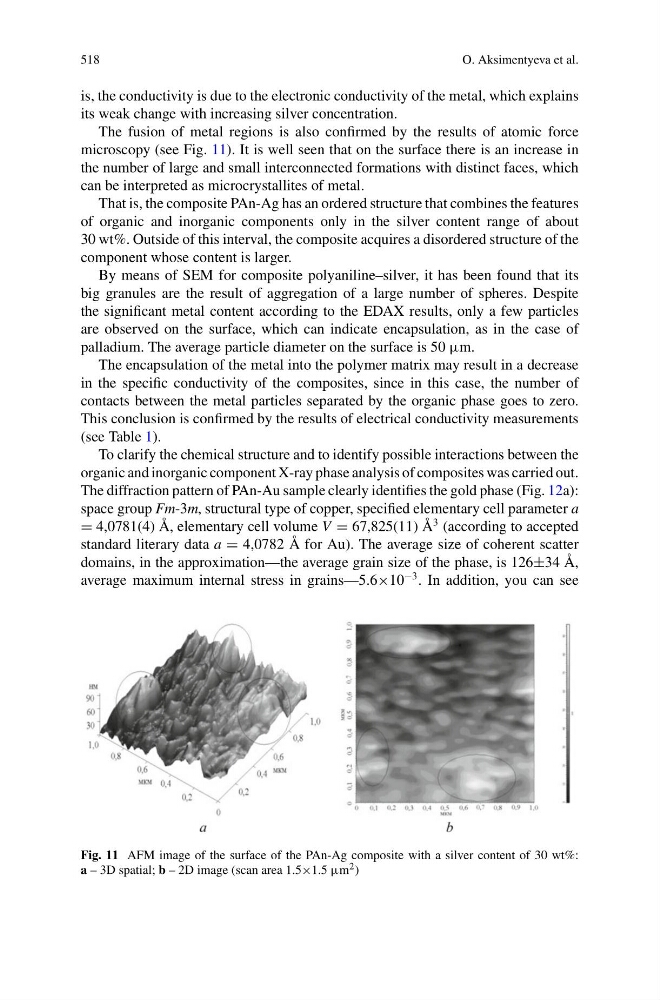
The fusion of metal regions is also confirmed by the results of atomic force
microscopy (see Fig. 11). It is well seen that on the surface there is an increase in
the number of large and small interconnected formations with distinct faces, which
can be interpreted as microcrystallites of metal.
That is, the composite PAn-Ag has an ordered structure that combines the features
of organic and inorganic components only in the silver content range of about
30 wt%. Outside of this interval, the composite acquires a disordered structure of the
component whose content is larger.
By means of SEM for composite polyaniline–silver, it has been found that its
big granules are the result of aggregation of a large number of spheres. Despite
the significant metal content according to the EDAX results, only a few particles
are observed on the surface, which can indicate encapsulation, as in the case of
palladium. The average particle diameter on the surface is 50 μm.
The encapsulation of the metal into the polymer matrix may result in a decrease
in the specific conductivity of the composites, since in this case, the number of
contacts between the metal particles separated by the organic phase goes to zero.
This conclusion is confirmed by the results of electrical conductivity measurements
(see Table 1).
To clarify the chemical structure and to identify possible interactions between the
organic and inorganic component X-ray phase analysis of composites was carried out.
The diffraction pattern of PAn-Au sample clearly identifies the gold phase (Fig. 12a):
space group Fm-3m, structural type of copper, specified elementary cell parameter a
= 4,0781(4) Å, elementary cell volume V = 67,825(11) Å
3 (according to accepted
standard literary data a = 4,0782 Å for Au). The average size of coherent scatter
domains, in the approximation—the average grain size of the phase, is 126±34 Å,
average maximum internal stress in grains—5.6×10
−3 . In addition, you can see
Fig. 11 AFM image of the surface of the PAn-Ag composite with a silver content of 30 wt%:
a – 3D spatial; b – 2D image (scan area 1.5×1.5 μm 2 )
O. Aksimentyeva et al.
is, the conductivity is due to the electronic conductivity of the metal, which explains
its weak change with increasing silver concentration.
The fusion of metal regions is also confirmed by the results of atomic force
microscopy (see Fig. 11). It is well seen that on the surface there is an increase in
the number of large and small interconnected formations with distinct faces, which
can be interpreted as microcrystallites of metal.
That is, the composite PAn-Ag has an ordered structure that combines the features
of organic and inorganic components only in the silver content range of about
30 wt%. Outside of this interval, the composite acquires a disordered structure of the
component whose content is larger.
By means of SEM for composite polyaniline–silver, it has been found that its
big granules are the result of aggregation of a large number of spheres. Despite
the significant metal content according to the EDAX results, only a few particles
are observed on the surface, which can indicate encapsulation, as in the case of
palladium. The average particle diameter on the surface is 50 μm.
The encapsulation of the metal into the polymer matrix may result in a decrease
in the specific conductivity of the composites, since in this case, the number of
contacts between the metal particles separated by the organic phase goes to zero.
This conclusion is confirmed by the results of electrical conductivity measurements
(see Table 1).
To clarify the chemical structure and to identify possible interactions between the
organic and inorganic component X-ray phase analysis of composites was carried out.
The diffraction pattern of PAn-Au sample clearly identifies the gold phase (Fig. 12a):
space group Fm-3m, structural type of copper, specified elementary cell parameter a
= 4,0781(4) Å, elementary cell volume V = 67,825(11) Å
3 (according to accepted
standard literary data a = 4,0782 Å for Au). The average size of coherent scatter
domains, in the approximation—the average grain size of the phase, is 126±34 Å,
average maximum internal stress in grains—5.6×10
−3 . In addition, you can see
Fig. 11 AFM image of the surface of the PAn-Ag composite with a silver content of 30 wt%:
a – 3D spatial; b – 2D image (scan area 1.5×1.5 μm 2 )