

Structure and Properties of Polyaniline Micro- and Nano …
517
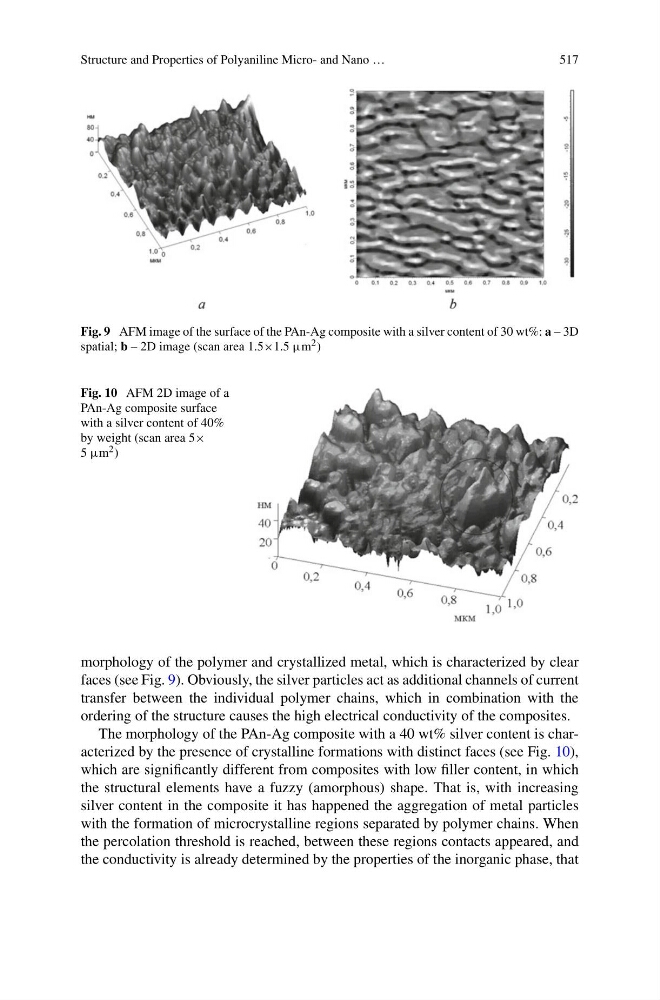
Fig. 9 AFM image of the surface of the PAn-Ag composite with a silver content of 30 wt%: a – 3D
spatial; b – 2D image (scan area 1.5×1.5 μm 2 )
Fig. 10 AFM 2D image of a
PAn-Ag composite surface
with a silver content of 40%
by weight (scan area 5×
5 μm 2 )
morphology of the polymer and crystallized metal, which is characterized by clear
faces (see Fig. 9). Obviously, the silver particles act as additional channels of current
transfer between the individual polymer chains, which in combination with the
ordering of the structure causes the high electrical conductivity of the composites.
The morphology of the PAn-Ag composite with a 40 wt% silver content is characterized by the presence of crystalline formations with distinct faces (see Fig. 10),
which are significantly different from composites with low filler content, in which
the structural elements have a fuzzy (amorphous) shape. That is, with increasing
silver content in the composite it has happened the aggregation of metal particles
with the formation of microcrystalline regions separated by polymer chains. When
the percolation threshold is reached, between these regions contacts appeared, and
the conductivity is already determined by the properties of the inorganic phase, that
517
Fig. 9 AFM image of the surface of the PAn-Ag composite with a silver content of 30 wt%: a – 3D
spatial; b – 2D image (scan area 1.5×1.5 μm 2 )
Fig. 10 AFM 2D image of a
PAn-Ag composite surface
with a silver content of 40%
by weight (scan area 5×
5 μm 2 )
morphology of the polymer and crystallized metal, which is characterized by clear
faces (see Fig. 9). Obviously, the silver particles act as additional channels of current
transfer between the individual polymer chains, which in combination with the
ordering of the structure causes the high electrical conductivity of the composites.
The morphology of the PAn-Ag composite with a 40 wt% silver content is characterized by the presence of crystalline formations with distinct faces (see Fig. 10),
which are significantly different from composites with low filler content, in which
the structural elements have a fuzzy (amorphous) shape. That is, with increasing
silver content in the composite it has happened the aggregation of metal particles
with the formation of microcrystalline regions separated by polymer chains. When
the percolation threshold is reached, between these regions contacts appeared, and
the conductivity is already determined by the properties of the inorganic phase, that