

Structure and Properties of Polyaniline Micro- and Nano …
513
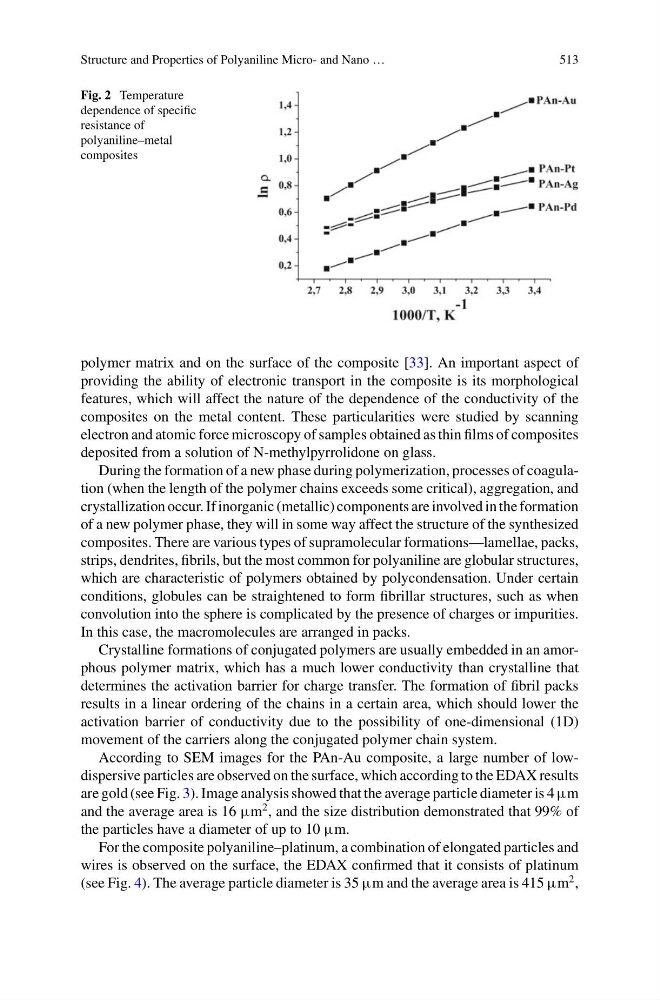
Fig. 2 Temperature
dependence of specific
resistance of
polyaniline–metal
composites
polymer matrix and on the surface of the composite [33]. An important aspect of
providing the ability of electronic transport in the composite is its morphological
features, which will affect the nature of the dependence of the conductivity of the
composites on the metal content. These particularities were studied by scanning
electron and atomic force microscopy of samples obtained as thin films of composites
deposited from a solution of N-methylpyrrolidone on glass.
During the formation of a new phase during polymerization, processes of coagulation (when the length of the polymer chains exceeds some critical), aggregation, and
crystallization occur. If inorganic (metallic) components are involved in the formation
of a new polymer phase, they will in some way affect the structure of the synthesized
composites. There are various types of supramolecular formations—lamellae, packs,
strips, dendrites, fibrils, but the most common for polyaniline are globular structures,
which are characteristic of polymers obtained by polycondensation. Under certain
conditions, globules can be straightened to form fibrillar structures, such as when
convolution into the sphere is complicated by the presence of charges or impurities.
In this case, the macromolecules are arranged in packs.
Crystalline formations of conjugated polymers are usually embedded in an amorphous polymer matrix, which has a much lower conductivity than crystalline that
determines the activation barrier for charge transfer. The formation of fibril packs
results in a linear ordering of the chains in a certain area, which should lower the
activation barrier of conductivity due to the possibility of one-dimensional (1D)
movement of the carriers along the conjugated polymer chain system.
According to SEM images for the PAn-Au composite, a large number of lowdispersive particles are observed on the surface, which according to the EDAX results
are gold (see Fig. 3). Image analysis showed that the average particle diameter is 4 μm
and the average area is 16 μm
2 , and the size distribution demonstrated that 99% of
the particles have a diameter of up to 10 μm.
For the composite polyaniline–platinum, a combination of elongated particles and
wires is observed on the surface, the EDAX confirmed that it consists of platinum
(see Fig. 4). The average particle diameter is 35 μm and the average area is 415 μm
2 ,
513
Fig. 2 Temperature
dependence of specific
resistance of
polyaniline–metal
composites
polymer matrix and on the surface of the composite [33]. An important aspect of
providing the ability of electronic transport in the composite is its morphological
features, which will affect the nature of the dependence of the conductivity of the
composites on the metal content. These particularities were studied by scanning
electron and atomic force microscopy of samples obtained as thin films of composites
deposited from a solution of N-methylpyrrolidone on glass.
During the formation of a new phase during polymerization, processes of coagulation (when the length of the polymer chains exceeds some critical), aggregation, and
crystallization occur. If inorganic (metallic) components are involved in the formation
of a new polymer phase, they will in some way affect the structure of the synthesized
composites. There are various types of supramolecular formations—lamellae, packs,
strips, dendrites, fibrils, but the most common for polyaniline are globular structures,
which are characteristic of polymers obtained by polycondensation. Under certain
conditions, globules can be straightened to form fibrillar structures, such as when
convolution into the sphere is complicated by the presence of charges or impurities.
In this case, the macromolecules are arranged in packs.
Crystalline formations of conjugated polymers are usually embedded in an amorphous polymer matrix, which has a much lower conductivity than crystalline that
determines the activation barrier for charge transfer. The formation of fibril packs
results in a linear ordering of the chains in a certain area, which should lower the
activation barrier of conductivity due to the possibility of one-dimensional (1D)
movement of the carriers along the conjugated polymer chain system.
According to SEM images for the PAn-Au composite, a large number of lowdispersive particles are observed on the surface, which according to the EDAX results
are gold (see Fig. 3). Image analysis showed that the average particle diameter is 4 μm
and the average area is 16 μm
2 , and the size distribution demonstrated that 99% of
the particles have a diameter of up to 10 μm.
For the composite polyaniline–platinum, a combination of elongated particles and
wires is observed on the surface, the EDAX confirmed that it consists of platinum
(see Fig. 4). The average particle diameter is 35 μm and the average area is 415 μm
2 ,